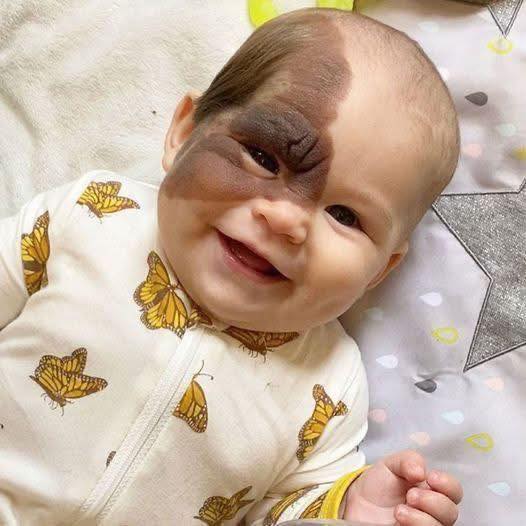
The moment Celine Casey held her newborn daughter in her arms, she experienced the familiar rush of awe and terror that so often accompanies new motherhood. In those first fragile hours, when everything feels heightened and every detail imprints itself forever, her eyes kept returning to the dark birthmark resting between her baby’s eyebrows. Doctors spoke calmly, explaining that it was harmless, purely cosmetic, and posed no medical threat. Friends and relatives reassured her that it was nothing to worry about. Yet for Casey, the mark became impossible to separate from the future she imagined for her child. She did not see danger or illness; she saw playgrounds, classrooms, and social spaces where difference can so easily turn into cruelty. In that tiny patch of skin, she envisioned questions her daughter would be too young to answer and judgments she would be forced to carry before understanding why.
As days turned into weeks, Casey found herself caught between medical reassurance and maternal instinct. The National Health Service declined to remove the birthmark, citing policy and the absence of medical necessity. From a clinical perspective, waiting made sense. But from a mother’s perspective, waiting felt like surrender. She feared that intervention would only come after emotional damage had already been done—after teasing, staring, or isolation had taken root. This was not about perfection or aesthetics, she insisted, but about prevention. She believed childhood should be light, not burdened by unnecessary pain inflicted by a world that often struggles to accept visible differences. The more she thought about it, the more convinced she became that acting early, before memory and identity formed, might spare her daughter an avoidable struggle.
With conventional options closed, Casey made a decision that would thrust her family into the public eye. She shared her story online, openly explaining her fears, her reasoning, and her hope to raise funds for private treatment. What followed was swift and overwhelming. Thousands of strangers responded, many sharing their own childhood experiences of being singled out for looking different. Parents recalled scars, braces, birthmarks, and insecurities that shaped their early years. Within 24 hours, more than $52,000 had been donated. The response transformed a deeply personal choice into a global conversation, revealing how many people understood the instinct to protect a child from harm—even when that harm had not yet occurred.
The path forward was not simple. The pandemic caused delays, costs rose, and Vienna would ultimately need three separate procedures. Each surgery required patience, recovery, and trust in a process that no parent enters lightly. Casey remained by her daughter’s side, enduring criticism as well as support, replaying her decision repeatedly in her mind. Slowly, the birthmark faded, replaced by a faint scar—one far less likely to define Vienna before she could define herself. The physical transformation was gradual, but the emotional weight lifted almost immediately for Casey, who felt she had acted in alignment with her deepest responsibility as a parent.
Criticism, however, never fully subsided. Some argued that removing the birthmark sent the wrong message about self-acceptance. Others questioned whether parents should alter a child’s appearance for social reasons. Casey listened but did not retreat. She emphasized that her choice was not a prescription for others, nor a rejection of difference. It was a decision made within the context of her child, her fears, and her understanding of the world as it is, not as it should be. She maintained that loving a child means preparing them for reality, even when that reality is uncomfortable, and making hard choices when protection feels more urgent than principle.
Today, Vienna is a lively toddler, unaware of the debates once centered on her face. She runs, laughs, and explores without the burden of a story she is too young to comprehend. Her future remains unwritten, but her mother believes it now holds one less obstacle. The discussion sparked by this family’s choice continues to echo, raising difficult questions about parenting, identity, and autonomy. Yet at its heart lies a universal truth: love often demands imperfect decisions made under imperfect conditions. For Celine Casey, the choice was clear. If she could spare her daughter even a fraction of future pain, she would act. And in doing so, she reminded the world that parenting is rarely about certainty—it is about courage, accountability, and choosing what feels right when no answer is free from doubt.