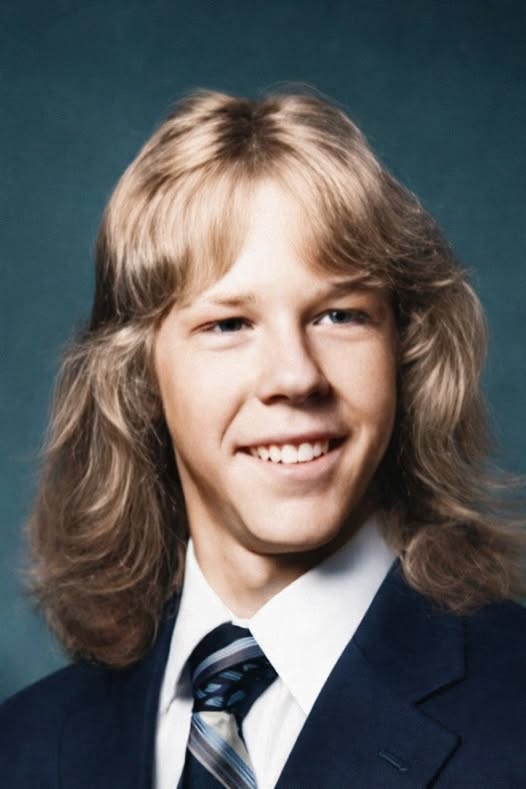
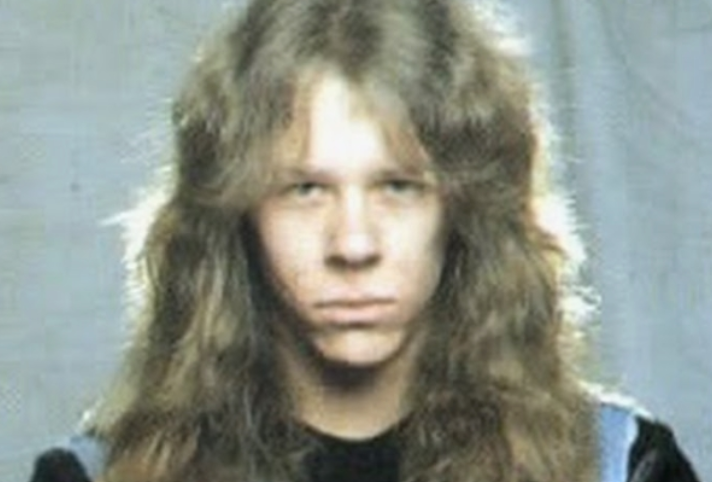
He did not look like a future icon when the earliest photos were taken—a sweet-faced boy with cautious eyes, unaware that grief would arrive early and carve its permanent mark. Born in Downey, California, James Hetfield’s childhood was shaped by instability, faith-driven medical neglect, and the devastating loss of both parents before adulthood. His mother’s death from cancer, after refusing conventional treatment, left a wound that would echo for decades, later surfacing in lyrics filled with anger, betrayal, and unanswered questions. Music entered his life not as a hobby but as a lifeline. Piano lessons came first, followed by drums, and eventually the guitar that would become his weapon of expression. In a home fractured by loss and silence, sound became the place where he could speak freely. These early experiences forged the emotional rawness that would later distinguish his songwriting from technical prowess alone. Even before fame, Hetfield was already learning how to survive by transforming pain into volume, distortion, and relentless honesty.
The formation of Metallica in the early 1980s marked a turning point not just for Hetfield, but for heavy metal itself. Alongside Lars Ulrich, he helped shape a band that rejected glam excess in favor of speed, aggression, and precision. As lead vocalist and rhythm guitarist, Hetfield’s down-picked riffs became legendary, creating a percussive style that drove the band’s ferocious sound. Albums like Kill ’Em All and Ride the Lightning announced a new force, while Master of Puppets elevated Metallica into artistic territory rarely reached by metal bands. Hetfield’s lyrics explored control, addiction, war, and inner collapse, reflecting both personal demons and broader human struggles. His voice—raw, commanding, and unapologetically intense—carried a sincerity that connected deeply with listeners. By the time …And Justice for All arrived, Metallica had become a defining voice of a generation disillusioned with authority and craving authenticity. Hetfield was no longer just channeling pain; he was leading a cultural movement.
The release of The Black Album in 1991 transformed Metallica from underground legends into global superstars. With a refined sound, slower tempos, and unforgettable hooks, the album brought songs like “Enter Sandman,” “The Unforgiven,” and “Nothing Else Matters” into the mainstream. For Hetfield, this success was both triumph and burden. Stadium tours, relentless schedules, and constant visibility intensified pressures he was never taught to manage. While millions celebrated the band’s dominance, the emotional cost mounted quietly behind the scenes. Hetfield’s commanding stage presence masked growing struggles with alcohol, control issues, and emotional repression. The very traits that fueled his success—discipline, intensity, and perfectionism—began to turn inward. Fame amplified everything: pride, fear, anger, and isolation. Even as Metallica conquered the world, Hetfield was fighting battles he could no longer outrun with sheer willpower.
By the late 1990s and early 2000s, the cracks were impossible to ignore. Tensions within Metallica escalated, creativity stalled, and Hetfield’s addiction reached a breaking point. In 2001, he entered rehab, stepping away from the band at a moment when its future seemed uncertain. This period, captured in the documentary Some Kind of Monster, revealed a side of Hetfield rarely seen—vulnerable, defensive, searching, and deeply human. The film exposed uncomfortable truths about masculinity, communication, and emotional survival within high-pressure creative partnerships. For Hetfield, rehab was not a cure but a confrontation with years of suppressed grief and rage. Learning to speak openly, accept help, and relinquish control challenged his identity as much as any musical evolution. Fans witnessed not a fallen hero, but a man choosing life over self-destruction, even when the process was messy and public.
Emerging from this period, Hetfield began a slow and deliberate reinvention. His voice matured, gaining depth and control, while his songwriting shifted toward reflection rather than pure fury. Albums like Death Magnetic and Hardwired… to Self-Destruct balanced aggression with clarity, proving that evolution did not mean abandonment of roots. Hetfield’s openness about sobriety, relapse, and recovery resonated deeply with fans navigating their own struggles. He no longer presented himself as invincible, but as accountable and self-aware. On stage, his presence remained commanding, yet grounded in gratitude rather than rage. Offstage, he embraced family life, personal boundaries, and continued self-work. This chapter of his life demonstrated that resilience is not about erasing scars, but learning how to live with them honestly.
Today, James Hetfield stands as more than a heavy metal icon; he is a testament to endurance, reinvention, and emotional truth. After more than four decades, his influence extends beyond riffs and records into the lives of millions who found solace in his words. His journey—from a grieving child to a global force, from addiction to accountability—embodies the complexity of survival in the public eye. Hetfield’s legacy is not defined solely by sales, awards, or stadiums filled with chanting fans, but by the courage to confront himself when success could no longer provide shelter. In a genre built on intensity, his greatest achievement may be proving that strength includes vulnerability. Through loss, rage, discipline, and healing, James Hetfield continues to remind the world that authenticity, earned the hard way, never goes out of tune.