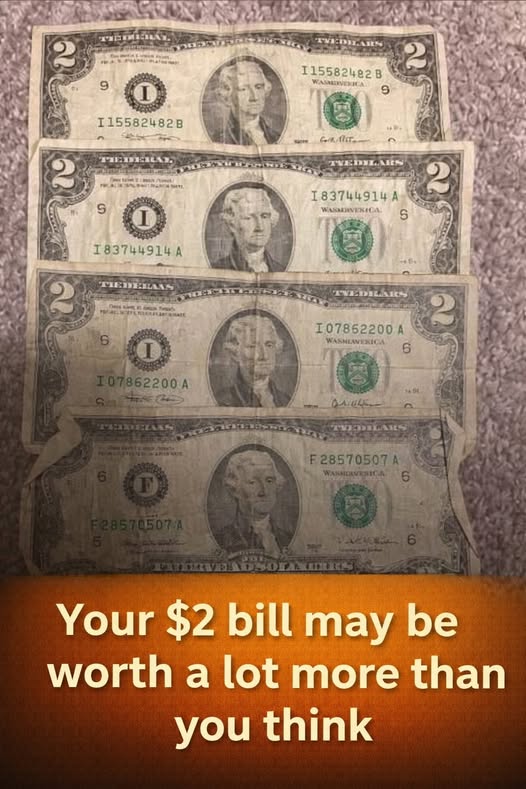
The humble $2 bill occupies a curious place in American currency, often mistaken for a novelty or assumed to be rare simply because it is seldom seen in daily transactions. Many people encounter one only occasionally—perhaps as a tip, a gift, or something rediscovered in an old wallet or drawer—and immediately wonder whether it holds special value. The truth is more nuanced. The $2 bill has a long and storied history that stretches back to the Civil War era, shaped by economic necessity, public perception, and shifting design choices. While most $2 bills in circulation today are worth exactly their face value, others—depending on age, condition, and rarity—can indeed be worth more. Understanding what separates an ordinary $2 bill from a collectible one requires looking beyond myths and into the details that collectors care about most.
The $2 bill was first introduced in 1862, during a time when the United States government was struggling to finance the Civil War and alleviate shortages of coins. From its earliest issues, the denomination was intended to fill a practical role rather than serve as a curiosity. Thomas Jefferson has appeared on the front of the bill since 1869, reinforcing its connection to early American history, while the reverse design has changed multiple times. The most recognizable modern version, introduced in 1976, features the signing of the Declaration of Independence, replacing the earlier image of Monticello. This redesign was meant to commemorate the nation’s bicentennial and renew interest in the denomination. Ironically, while millions of these notes were printed, public reluctance to use them helped cement the idea that the $2 bill was rare, even though it was never officially discontinued.
Public perception has played a significant role in shaping the $2 bill’s reputation. For decades, rumors circulated that the bill was unlucky, discontinued, or somehow special, causing many people to save rather than spend them. Businesses sometimes refused to accept them, further reinforcing the misconception that they were no longer legal tender. In reality, the U.S. Treasury continues to print $2 bills periodically, though in much smaller quantities than other denominations. This limited circulation—not actual scarcity—explains why they feel unusual. As a result, many people tuck them away as keepsakes, unintentionally removing them from everyday use and perpetuating their mystery. This cycle of misunderstanding has made the $2 bill one of the most recognizable yet least understood forms of American money.
When it comes to actual value, most $2 bills printed from 1976 onward are worth exactly $2 unless they have special characteristics. Collectors look for specific features that elevate a note’s worth, such as unusual serial numbers, star notes, printing errors, or exceptional condition. Older bills, particularly those issued before 1963 with red seals, tend to attract more interest. For example, a 1953 or 1963 red seal $2 bill in average circulated condition might sell for a modest premium, while one in uncirculated or near-perfect condition can fetch significantly more. Star notes—identified by a star at the end of the serial number—are replacement notes printed in smaller quantities and are especially appealing to collectors. However, dramatic price increases apply only to specific combinations of rarity and condition, not to every old-looking bill.
Condition is one of the most critical factors in determining value. A crisp, uncirculated $2 bill with sharp corners, no folds, and vibrant ink will always be worth more than one that has been heavily handled. Collectors use standardized grading systems to assess a bill’s state, ranging from poor to gem uncirculated. Even a potentially valuable note can lose much of its worth if it is creased, stained, or damaged. This is why experts often advise against folding, laminating, or otherwise altering old currency. While it may be tempting to “protect” a bill, improper handling can actually reduce its value. For those who suspect they have a collectible $2 bill, professional appraisal or comparison with reputable currency guides is the safest way to determine its true worth.
Beyond monetary value, the $2 bill holds cultural and historical significance that extends far beyond its price tag. It has been used in unique ways throughout American history, from political campaigns to regional traditions. In some communities, $2 bills are used to support local businesses or commemorate special events, stamped with dates or locations. Collectors often appreciate them not just as currency, but as artifacts that reflect changing attitudes toward money, trust, and symbolism. The enduring fascination with the $2 bill speaks to a broader human tendency to attach meaning to objects that feel different or overlooked, even when their practical value remains unchanged.
In the end, finding a $2 bill in your possession is unlikely to make you rich, but it does connect you to a distinctive piece of American history. Most are worth exactly what they say, yet some carry additional value due to age, rarity, or condition. More importantly, the $2 bill serves as a reminder that not everything unusual is rare, and not everything rare is immediately obvious. Whether you choose to spend it, save it, or explore its background further, the $2 bill remains a small but fascinating symbol of how perception, history, and value intersect in everyday life.