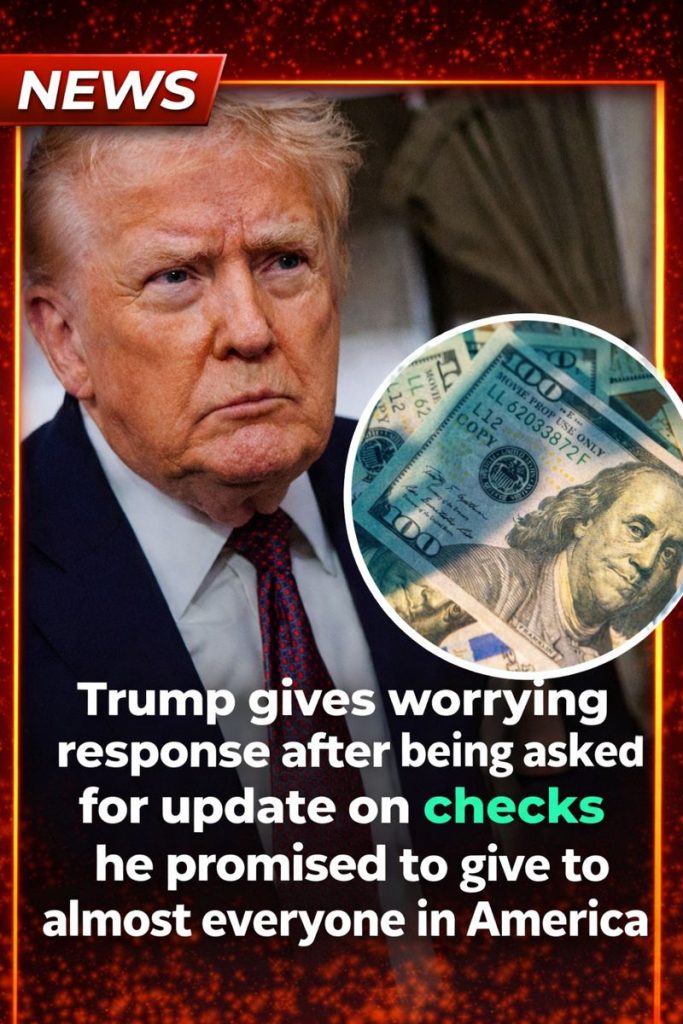
When pressed by journalist Katie Rogers about the promised $2,000 checks, former President Donald Trump hesitated, revealing cracks in a pledge that millions of Americans had quietly budgeted into their financial plans. His response blurred the lines between a direct payment promise and a separate $1,776 bonus earmarked for service members, creating confusion over who would receive money and when. Trump eventually asserted that the payments would arrive “toward the end of the year,” funded by “substantial” revenue from tariffs, but the numbers raise questions about feasibility. Analysts estimate the total cost of the checks at around $600 billion, while only roughly $90 billion has been collected through tariffs so far, leaving a significant gap and uncertainty about how the program could be fully financed.
The potential Supreme Court ruling on the legality of the tariff revenue adds another layer of unpredictability. Should the Court rule against the administration, much of the collected funds could be subject to refunds, leaving the plan underfunded and timelines in doubt. For households counting every dollar, the difference between expectation and reality has very real consequences. Families who had tentatively planned for additional support now face uncertainty, uncertain if promised stimulus will materialize, or whether they should adjust their spending and saving strategies accordingly. The mismatch between public statements and practical financial realities underscores the challenges of relying on politically contingent sources of revenue.
Economists have weighed in, warning that funding large-scale direct payments with tariffs can be risky. Tariff-funded checks introduce complex ripple effects in the economy: higher import costs can fuel inflation, strain supply chains, and disproportionately affect consumers who already face rising prices. Republican critics have questioned the wisdom of using tariff revenue in this way, arguing that it may destabilize both markets and household budgets. Meanwhile, the administration emphasizes that Americans should exercise financial caution, saving money they have not yet received, highlighting the uncertainty and conditional nature of the plan.
The political dimension of Trump’s statements is equally significant. Promises of direct payments are often politically charged, signaling both intent and responsiveness to public need. Yet hesitation, ambiguity, and shifting explanations risk undermining public trust. Americans are left to reconcile statements made on camera with the practical realities of fiscal policy, tariff collection, and judicial oversight. In the gap between promise and reality, faith in government messaging becomes central: households must decide whether assurances are credible or merely aspirational. This uncertainty can shape public perception, influence spending decisions, and create political pressure far beyond the immediate financial impact of the checks themselves.
The discussion surrounding the $2,000 payments also illuminates broader questions about economic governance and transparency. Using tariffs as a funding mechanism ties stimulus directly to international trade and the unpredictable behavior of global markets, complicating long-term planning. If tariff revenue falls short or must be refunded, Americans could experience delays or reductions in promised benefits, leaving families vulnerable and potentially eroding confidence in federal commitments. At the same time, policy decisions framed as immediate relief carry symbolic weight, signaling responsiveness to voter priorities even when feasibility is uncertain.
Ultimately, the episode highlights the tension between political promise and economic reality. Trump’s remarks, whether interpreted as confusion, hedging, or strategic caution, underscore the challenges of delivering high-cost direct payments funded by uncertain sources. For households, the stakes are immediate and tangible: budgeting, spending, and saving decisions hinge on whether the checks actually arrive. For policymakers and economists, the episode is a reminder that rhetoric alone cannot substitute for concrete planning. In the intersection of public expectation, judicial oversight, and economic mechanics, what is really at stake is trust—trust that government words hold meaning when the cameras are off and that promised support is more than a headline.