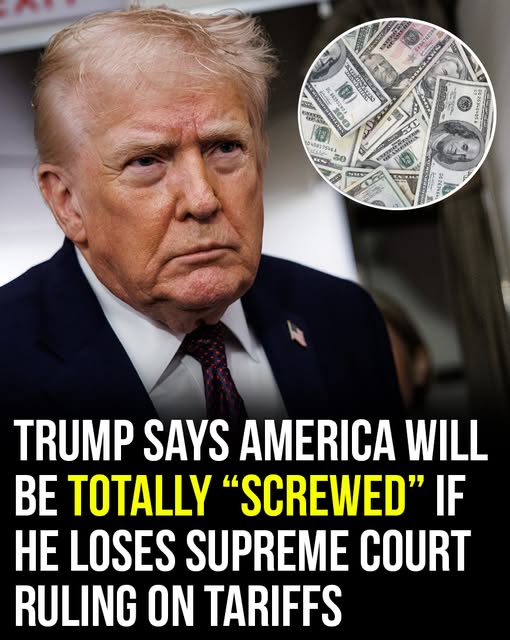
President Donald Trump has once again thrust his tariff policy into the national spotlight, warning that the United States would face severe economic consequences if the Supreme Court strikes down his sweeping trade measures. For Trump, tariffs are not merely a policy tool but a cornerstone of his broader economic vision, one he believes protects American workers, strengthens domestic manufacturing, and reasserts U.S. leverage on the global stage. Speaking through an extended post on Truth Social, the president described a potential ruling against the tariffs as a “complete mess,” arguing that the financial fallout could reach staggering proportions. According to Trump, undoing the tariffs would not only require refunding vast sums already collected but could also trigger demands for compensation tied to long-term investments made by companies seeking to avoid tariff costs. In his framing, the case is not simply about trade policy—it is about whether America can defend itself economically in an increasingly competitive world.
At the heart of the legal battle is the question of presidential authority. Trump imposed the tariffs by invoking the International Emergency Economic Powers Act, a 1977 law that grants presidents broad economic powers during declared national emergencies. By declaring persistent trade deficits a national emergency, his administration justified imposing tariffs on more than $150 billion worth of imports from major trading partners, including China, India, Canada, and the European Union. Supporters argue the move was long overdue, saying decades of trade imbalances hollowed out American manufacturing and left the country economically vulnerable. Critics counter that the law was never intended to justify such sweeping, long-term trade actions without congressional approval. Lower courts agreed with the critics, ruling that the tariffs exceeded the president’s authority, setting the stage for a Supreme Court decision with far-reaching implications.
Trump’s warnings focus heavily on the potential financial consequences of reversing the tariffs. He claims that if the court rules against his administration, the U.S. government could be forced to repay hundreds of billions of dollars collected from importers, a process he describes as administratively overwhelming and financially destabilizing. Beyond direct refunds, Trump argues that companies and foreign governments could seek additional compensation for investments made in response to the tariffs, including new factories, plants, and equipment. When these long-term commitments are factored in, he contends, the total cost could climb into the trillions. In his words, even calculating who would be owed what, and over what timeframe, could take years. This uncertainty, he argues, would undermine confidence in U.S. economic policy and weaken America’s negotiating position worldwide.
The controversy has intensified amid Trump’s latest tariff move, which imposes a 25 percent levy on goods from any country that maintains commercial ties with Iran. Announced as “effective immediately,” the measure reflects Trump’s belief that economic pressure is one of the most powerful tools available to the United States. Iran, already struggling under extensive sanctions, faces worsening inflation and rising food prices, and the new tariffs could deepen those challenges by disrupting trade with key partners such as China, Iraq, Turkey, and the United Arab Emirates. Supporters see the move as a firm stance against hostile regimes, while critics warn it could exacerbate humanitarian suffering and strain relationships with allies caught in the middle. The scale and speed of the policy have fueled broader concerns about the global ripple effects of Trump’s trade strategy.
Opposition to the tariffs has been fierce and wide-ranging. Business groups, importers, and trade organizations argue that the costs of the tariffs are ultimately borne by American consumers through higher prices and supply chain disruptions. Smaller nations have complained of being disproportionately affected, while U.S. companies report increased customs complications and uncertainty. Politically, Trump has also faced criticism for bypassing Congress, with opponents warning that allowing such expansive executive authority sets a dangerous precedent. More than a thousand lawsuits have been filed challenging the tariffs, reflecting both economic anxiety and constitutional concern. Even within the administration, officials have sought to temper Trump’s most dire warnings, noting that while refunds could be complex, the Treasury has mechanisms to manage potential repayments over time.
Ultimately, the Supreme Court’s decision will shape more than just the fate of Trump’s tariffs. It will clarify the limits of presidential power in trade and national emergency declarations, influencing how future administrations respond to economic threats. For Trump, the case represents a defining moment—one that, in his view, will determine whether America can act decisively to protect its economic interests. His stark warning that the country would be “screwed” if the tariffs are overturned captures both the urgency and the drama he brings to the debate. Whether that prediction proves accurate remains uncertain, but what is clear is that the ruling will leave a lasting mark on U.S. trade policy, constitutional law, and America’s role in the global economy.