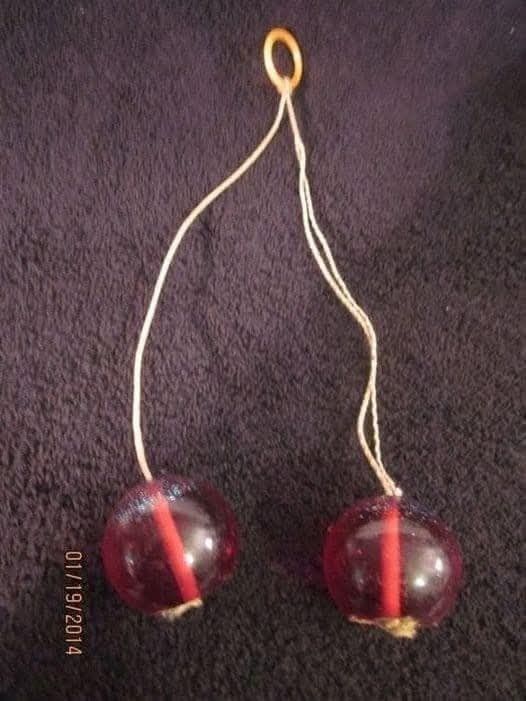
At first glance, the object seems alien, almost unsettling. Two clear red spheres dangle from strings, each containing a solid red line suspended inside, with no instructions or apparent function. Photos of it went viral online, and the guesses came pouring in: medical device, fishing tool, ritual object, experimental gadget. Engineers, collectors, and casual viewers alike were stumped. The confusion wasn’t because the object was complex, but because it came from an era most people today barely remember—or never experienced at all. Its design, simple yet visually hypnotic, defied contemporary expectations for toys, blurring the line between plaything and experiment.
The answer is far simpler than the wild speculations suggested: this object is a vintage clacker toy, a phenomenon that captivated children in the late 1960s and early 1970s. The toy consisted of two hard plastic or acrylic balls attached by strings to a small ring or loop. Players would hold the ring and swing the balls up and down so they clacked together rhythmically. The challenge was speed and control: swing too fast or unevenly, and the balls could fly off unpredictably. Some clackers were solid plastic, but others—like the one in the photo that sparked internet debate—were liquid-filled, giving them the mesmerizing moving stripe inside. That simple liquid feature is what caused the confusion: without context, it looked engineered, technical, or even dangerous, when in reality, it was just visual flair designed to captivate the eye.
At the time, clackers were a cultural craze. Kids competed for speed records, skill, and showmanship. The liquid-filled versions were considered particularly stylish. When swung, the internal colored stripe created a hypnotic motion, especially when sunlight hit the spheres. The combination of sound and visual movement made them irresistible. For a brief period, clackers were everywhere: playgrounds, birthday parties, schoolyards. Their popularity even inspired homemade modifications, with children experimenting with different weights, ball sizes, and string lengths. The toy’s charm lay in its simplicity: a sound that echoed with every swing, a visual rhythm, and the satisfaction of mastering control over an object that seemed almost alive in its movement.
Yet the very qualities that made clackers thrilling also made them dangerous. The hard plastic balls could shatter if mishandled, sending shards flying with potentially serious consequences. Stories of broken wrists, chipped teeth, and emergency room visits became common enough that schools banned them, and cautious parents discarded them entirely. By the mid-1970s, the clacker craze was over, leaving behind a generation of children who remembered the excitement—and adults who now chuckled at the perceived absurdity of the toy. Safety standards at the time were flexible, and clackers represented both the thrill and recklessness of the era. Their disappearance ensured that subsequent generations, unfamiliar with their quirks and hazards, would be bewildered by images of the object decades later.
Today, when a vintage clacker appears online, the reactions are intense and often confused. Viewers unfamiliar with the toy see precision, design, and mystery where there was only play. The suspended line of colored liquid inside the ball looks like instrumentation, experimentation, or a carefully engineered gimmick, not the simple feature of a toy intended to dazzle and entertain. The viral nature of these posts shows how objects from a brief cultural moment can lose context entirely over time, transforming ordinary childhood items into seemingly cryptic artifacts. What was once everyday fun becomes a puzzle, highlighting how easily memory and context shape perception.
Ultimately, the clacker toy is a reminder of an era where play was loud, risky, and imaginative. It represents the fleeting crazes of childhood and the way objects can take on mythic qualities when removed from their original context. While not a medical device, weapon, or scientific instrument, it captivated generations and now intrigues a new audience decades later. For those who grew up with it, the clacker remains nostalgic—a simple, noisy, dangerous joy. For everyone else, it is a lesson in how history, even in the form of a toy, can baffle, delight, and challenge assumptions, reminding us that sometimes the strangest objects have the simplest origins.