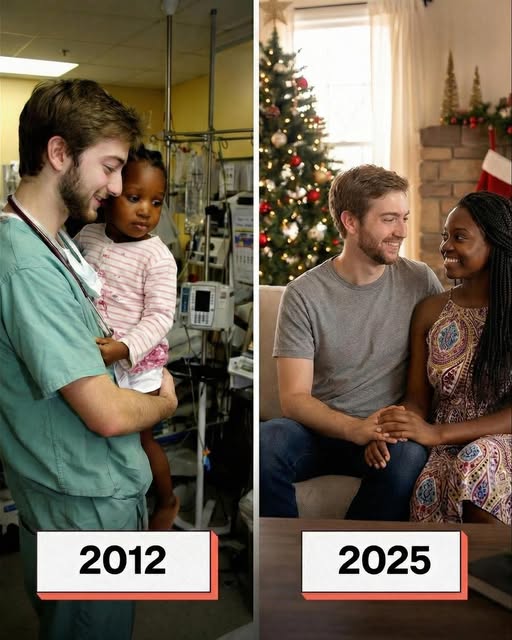
Thirteen years ago, my life revolved around fluorescent lights, trauma bays, and the steady rhythm of alarms that never seemed to stop. I was twenty-six, newly board-certified, and still trying to convince myself that exhaustion was temporary and purpose was enough to sustain a person indefinitely. That night began like so many others—an ambulance call crackling over the radio, the rushed choreography of a team preparing for the worst, the quiet mental checklist that kept panic at bay. When the stretchers came in from the collision, I saw the familiar stillness that told me two lives had already slipped away. Then there was Avery. Small, trembling, impossibly alert. Her eyes tracked every movement in the room, not with fear exactly, but with the raw confusion of a child whose world had collapsed without warning. She reached for me without knowing my name, as if instinct alone had decided I was safe. When she whispered that she was scared and begged me not to leave, something inside me broke open in a way no textbook ever described. I stayed because I couldn’t imagine doing otherwise, and in that moment, the boundaries I’d spent years learning dissolved into something far more human.
What was meant to be a temporary kindness quietly reshaped my entire existence. One night became a week filled with paperwork and whispered phone calls during breaks, then months of home inspections, parenting classes, and court dates squeezed between overnight shifts. I learned how to braid hair at dawn after twelve hours on my feet, how to cook something resembling dinner that didn’t come from a vending machine, how to read bedtime stories with one eye open and still make it feel magical. Avery adapted with a resilience that humbled me. She carried her grief like a small, carefully guarded stone, rarely speaking of the parents she lost, but she watched me constantly, as if measuring whether this new world was stable enough to trust. The first time she called me “Daddy” wasn’t dramatic. It happened in a grocery store aisle, her voice barely audible over the hum of refrigerators. She looked up immediately, eyes wide, bracing for correction. Instead, I knelt beside her and told her that if she wanted, she could call me that forever. From that day on, every choice I made—every shift I accepted, every move I considered—was filtered through a single question: what would keep her safe?
The years passed in a blur of ordinary miracles. First days of school, science fair disasters, late-night talks about bullies and broken friendships, shared jokes that only made sense to us. Avery grew into herself with a confidence that surprised even her teachers. She was stubborn in the best way, compassionate without being naïve, and fiercely loyal to the people she loved. I watched her discover music, argue passionately about social issues, and develop a sarcasm sharp enough to rival any ER veteran. I didn’t date much; my life felt full in a way that didn’t leave much room for longing. When loneliness crept in, it was quiet and manageable, easily outweighed by the privilege of being someone’s constant. Friends told me I was missing out, that I deserved more, but I never felt deprived. I felt chosen. That sense of certainty made me careless in one crucial way: I believed love, once earned, was self-evident and unassailable.
Meeting Marisa felt less like falling and more like settling into something already familiar. She was a nurse practitioner with a dry wit and an intuitive understanding of the rhythms of hospital life. She remembered details that mattered to Avery—favorite drinks, upcoming exams, the way she liked her room rearranged when she was stressed. Watching them laugh together eased a part of me I hadn’t realized was tense. For the first time, I allowed myself to imagine a future that expanded rather than disrupted what we already had. I bought a ring quietly, savoring the idea that I was building something stable, something deserved. When the accusation came, it was so out of place it felt unreal. Marisa showed me security footage and spoke in careful, sympathetic tones, suggesting that Avery might be acting out, that teenage rebellion sometimes took ugly forms. My heart pounded, not with anger, but with a desperate need to understand. Avery’s confusion was immediate and visceral. She insisted her hoodie had gone missing days earlier, her voice shaking not with guilt but with fear—fear that I might doubt her. That fear cut deeper than any betrayal could have.
I checked the footage myself because I needed truth more than reassurance. What I found shattered whatever fragile assumptions I had been clinging to. Marisa, wearing Avery’s hoodie, opening my safe with deliberate calm, filming herself taking the money, constructing a lie that placed my daughter squarely in its center. The realization didn’t explode; it settled cold and heavy in my chest. When I confronted her, the mask slipped completely. Her words were sharp, dismissive, and revealing in their cruelty. She said Avery wasn’t my real family, as if biology were the only currency that counted, as if thirteen years of love and responsibility could be dismissed with a sentence. I didn’t argue. I opened the door and told her to leave because there was nothing left to negotiate. The moment wasn’t dramatic; it was final. Avery stood on the stairs, silent tears streaking her face, waiting to see whether the ground beneath her would hold. I crossed the room in two steps and pulled her into my arms, telling her the only truth that mattered: she was my daughter, always had been, always would be.
In the aftermath, I learned how fragile stability can feel even when it’s real. Trust, once threatened, needs reaffirmation through action, not words. Avery didn’t need grand gestures; she needed consistency. She needed to see that my routines didn’t change, that my affection didn’t waver, that my choice of her was not conditional on convenience or comfort. We talked openly, sometimes awkwardly, about betrayal and fear and the quiet ways adults can fail children without intending to. I apologized for bringing someone into our lives who hurt her, and she forgave me with a generosity that reminded me who the stronger person was. Over time, laughter returned, tentative at first, then full-bodied and familiar. The experience didn’t harden us; it clarified us. I understood with painful clarity that parenthood isn’t defined by origin stories but by the daily willingness to stand between your child and harm, no matter where that harm comes from. Love isn’t proven in moments of ease; it’s proven when doing the right thing costs you something you thought you wanted.
Looking back, I see that night in the ER as the beginning of a life I couldn’t have planned but wouldn’t trade for anything. Avery didn’t just change my schedule or my priorities; she changed my understanding of family, loyalty, and courage. The secret that was revealed didn’t undo what we built; it tested it, and in doing so, made it unbreakable. I remain an ER doctor, still navigating chaos and uncertainty, but my center is firm. It’s in the shared glances across a crowded room, the late-night talks about the future, the quiet knowledge that being chosen once doesn’t exempt you from choosing again, every day. And every day, without hesitation, I choose her.