The night everything began to unravel arrived quietly, without the dramatics one might expect. It seeped in like exhaustion after months of pretending endurance equaled stability. The kitchen clock glowed faintly in the dark, and I stood alone, realizing that a life could fracture without a sound. By that point, my husband Caleb had already filed for divorce. On paper, his reasons appeared calm, rational, and restrained. He claimed we had grown apart, that arguments had become frequent, and that I was emotionally overwhelmed, struggling to manage stress. He painted himself as dependable, a stabilizing force in our family, and I, fatigued and worn, initially lacked the energy to challenge that narrative. I did not yet see that what I perceived as reality was slowly being rewritten by someone else’s carefully curated version.
Our daughter, Harper, was ten years old, teetering between awareness and innocence. She could sense the tension but still believed adults knew what they were doing—or at least should know. What I did not know was that she had been carrying a weight entirely on her own, one she lacked the language to articulate. While I wrestled with legal filings, financial uncertainty, and sleepless nights, she learned to survive quietly. The proceedings moved swiftly, propelled by Caleb’s confidence and the calm authority of his attorney, who depicted me as fragile, reactive, and unfit to maintain household stability. Sitting in the courtroom, I felt like an observer in my own life, as my husband’s version of events became the dominant narrative, leaving me with no evidence strong enough to interrupt the story being told.
I longed to explain the invisible truths of our home: the tension that coiled in my body at the shift of his mood, the way air thickened when his voice hardened, the early signs that danger was brewing before a word was even spoken. Yet none of this seemed measurable, admissible, or real in the eyes of the law. Harper sat beside me, her small feet dangling, her hands folded neatly, and her eyes fixed on the wood grain of the courtroom bench. She was quieter than usual, but the most important voice in the room had not yet spoken. And when the judge asked if there was anything further to add, I shook my head, resigned to the slow erosion of fairness that had been meticulously rehearsed without my participation.
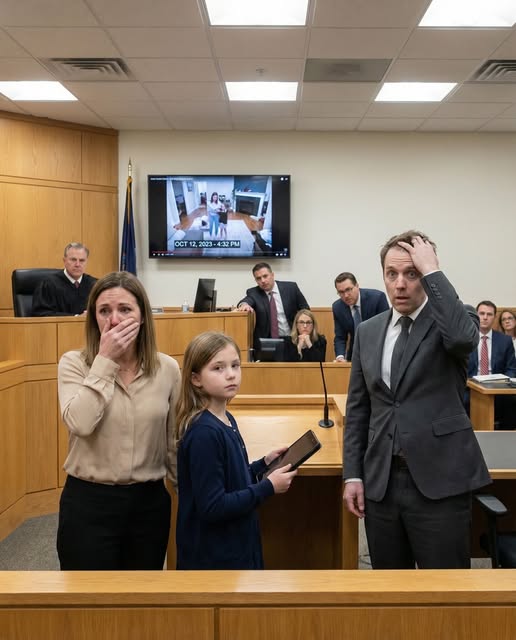
Then Harper rose. The scrape of her chair was soft but noticeable. “Your Honor, can I show you something Mommy doesn’t know?” she asked, her voice small but steady. The room fell silent. The judge leaned forward, his expression cautious but attentive, and asked if she felt safe speaking. She nodded, hands trembling at her sides. My instinct was to shield her, to pull her back into the safety of silence, but I stayed still, understanding that her voice needed to be heard. From her pocket, she retrieved a small tablet, smudged with fingerprints and worn at the edges. She explained that she had recorded the video because she feared forgetting the events she could not yet name. When it was displayed on the courtroom screen, I felt an eerie mix of dread and clarity.
The video was timestamped late at night. Our familiar kitchen appeared on screen, and then Caleb’s voice cut through, raw and unpolished, shouting not at me, but at Harper. The words were sharp, blaming, demanding silence, warning her not to tell me what was happening. Harper’s trembling voice asked for me repeatedly. At one point, the sound of something breaking made people in the courtroom flinch. I felt detached, watching a truth I had sensed but never fully seen. When the video ended, silence hung heavy, and the judge’s demeanor had shifted, the professional mask replaced by the weight of what had been revealed. Harper’s reasoning was simple: if she forgot, it might never be acknowledged. By speaking, she preserved reality, and with it, her safety.
In the weeks that followed, the entire language of the case transformed. Evaluations were ordered. Supervised visits were mandated. Therapy and protective measures were put in place. Where Caleb had once appeared the stabilizing parent, the legal record now documented concern, risk, and caution. I was granted primary custody—not as a victory, but as a necessary safeguard. Outside the courthouse, Harper clung tightly to my hand, the tension she had carried for so long beginning to release. She whispered apologies for her silence, and I reassured her that fear does not erase bravery. In her quiet act, she had not only protected herself but reshaped the family’s path. Healing was gradual, measured in therapy sessions, hard conversations, and the slow release of guilt imposed by hindsight. Laughter returned to our home. Sleep returned to our nights. The transformation was profound but slow.
That day in court redefined my understanding of strength and authority. Sometimes, power looks like control, presence, or expertise. Sometimes, it is embodied in the quiet, unwavering courage of a small child willing to risk speaking when adults have failed to notice. Harper’s act did more than influence custody arrangements; it reshaped the way I understood resilience, truth, and protection. It reminded me that voices, even the softest ones, have the power to change outcomes, restore balance, and affirm humanity. In the aftermath, I learned that listening—truly listening—can be the most potent form of courage, and that bravery often comes in the form of whispered words and unseen actions carried out in silence.