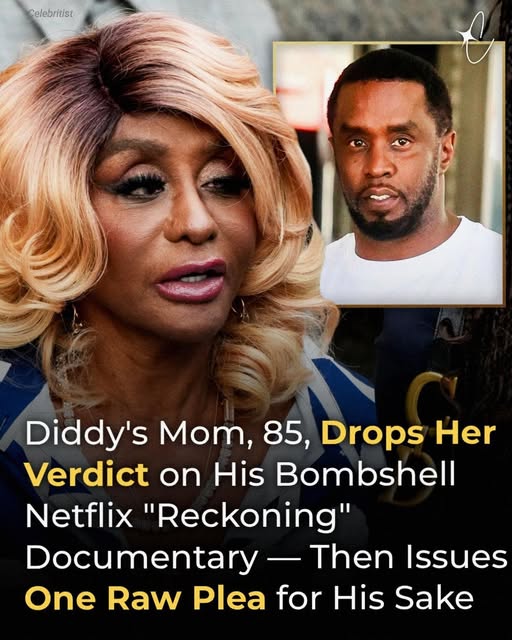
Janice Combs, mother of music mogul Sean “Diddy” Combs, stepped forward publicly for the first time after the release of the Netflix documentary Sean Combs: The Reckoning, which immediately drew widespread attention and debate. Known for keeping a private life, Janice had avoided media commentary while the documentary made its rounds, leaving fans and critics to speculate. Her carefully worded statement addressed allegations made in the film while defending her son against claims she described as inaccurate and misleading. While she acknowledged that no public narrative can perfectly capture a person’s life, she emphasized that the documentary relied heavily on selective storytelling and hearsay, leaving out context that only those within the family truly understand. Janice’s words reflected a desire to correct the record and highlight the human side of a story dominated by headlines and edited sequences, reminding the public that there is a difference between perception and reality.
The documentary had presented a mixture of archival footage, interviews with associates, and dramatic storytelling designed to engage viewers. Within this context, Janice expressed concern that some claims, particularly those regarding Diddy’s personal conduct and family interactions, were either exaggerated or outright false. One claim she specifically refuted involved an allegation of violence toward her decades ago, which she called “patently false” in her public statement. Her measured approach avoided sensational language, choosing instead to highlight the importance of fact over rumor. She stressed that the life of her son—a man who has spent decades in the public eye, building an entertainment empire and managing complex personal and professional responsibilities—cannot be distilled into a series of accusations. By framing her response around truth and verification, Janice positioned herself as a voice of reason amid the storm of opinion and speculation.
Janice also addressed the broader impact of the documentary on the family, noting that while Diddy has always been in the public eye, this new wave of scrutiny carries unique challenges. She highlighted that family members, especially parents, often feel a profound sense of responsibility and vulnerability when personal matters are broadcast to millions of viewers. Although the documentary presented certain events and narratives as definitive, she stressed that these accounts were incomplete and sometimes misleading. For Janice, the experience underscored a larger societal concern: the way entertainment platforms can frame personal histories as drama, sometimes at the expense of the individuals involved. Her perspective serves as a reminder that behind every headline and streaming series is a human story with nuance and complexity that cannot be reduced to soundbites.
The timing and manner of Janice’s response were notable. Coming after weeks of public discourse and social media speculation, her statement sought to recalibrate the conversation. She emphasized respect for truth and asked viewers to consider the consequences of consuming and repeating unverified claims. Her comments reflected a balance between maternal loyalty and advocacy for fairness, highlighting that supporting a loved one does not require ignoring facts, but rather contextualizing them responsibly. By articulating this position, Janice reminded audiences that families often endure public scrutiny in silence, and their perspectives deserve acknowledgment. The measured tone of her response contrasted with the sensationalism of the documentary, signaling that calm, deliberate engagement can be more powerful than reactive defense or outrage.
Media reaction to her statement was varied, with some outlets applauding her courage and clarity, and others critiquing her for speaking at all. Despite differing interpretations, her intervention shifted the discourse from speculation to consideration of evidence and context. Commentators noted that her approach humanized Diddy and his family, presenting them not as caricatures in a media narrative but as real people grappling with complex life events. This approach also highlighted a broader cultural tension between storytelling as entertainment and storytelling as truth, particularly in the age of streaming platforms and social media amplification. Janice’s public stance encouraged viewers to approach such documentaries critically, questioning the framing of content and remaining aware of potential biases and omissions.
Ultimately, Janice Combs’ public comments serve as a case study in navigating public life, media scrutiny, and personal loyalty. She reaffirmed her belief in her son as a man she has known and loved throughout his life, while also insisting that audiences approach claims with skepticism and patience. By emphasizing the importance of context, verification, and empathy, she offered a model for responding to sensationalized media while maintaining dignity and integrity. Her words remind the public that behind every documentary, headline, or viral post lies a family experiencing real emotions and consequences. In doing so, Janice Combs not only defended her son but also highlighted the broader implications of media narratives in shaping public perception, demonstrating that truth, when approached thoughtfully, remains a powerful tool against distortion and speculation.