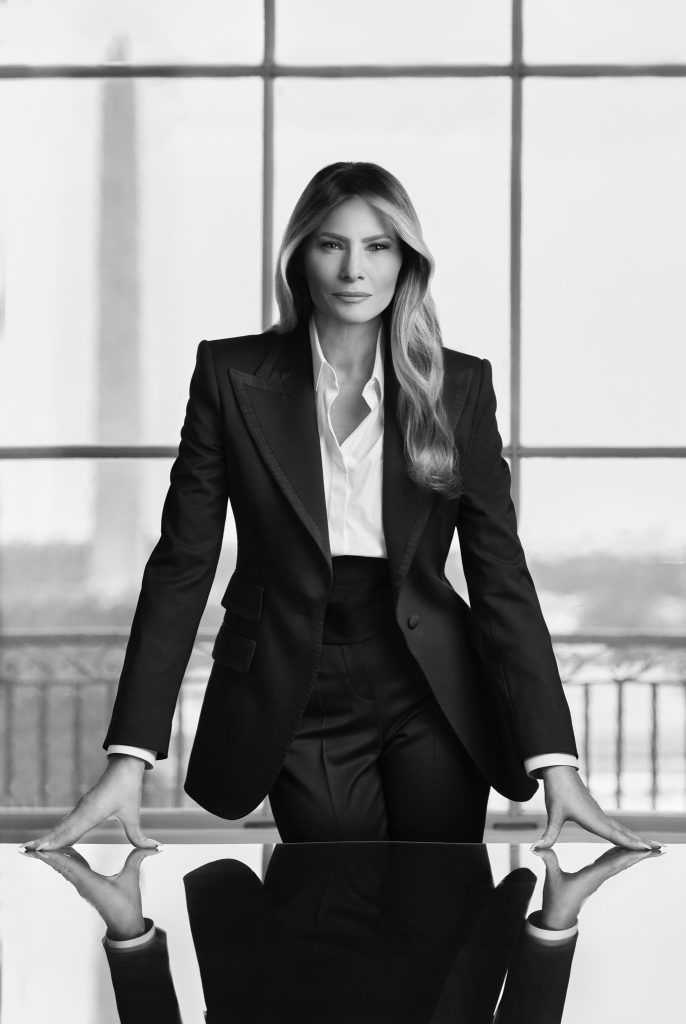
When the White House unveiled Melania Trump’s official portrait on January 28, 2025, it immediately became much more than a photograph—it became a cultural event, a source of commentary, and, for many observers, a visual manifesto. The black-and-white image, captured by Belgian photographer Régine Mahaux, marks a distinct stylistic departure from the softer tones and more approachable sensibility of Melania’s 2017 portrait. In this new photograph, she appears in a tailored black suit and white shirt, her hands placed firmly on a reflective tabletop, as the Washington Monument looms behind her through the windows of the Yellow Oval Room. The composition feels deliberately powerful, its stark contrasts and assertive pose conveying a presence that has been interpreted in vastly different ways by audiences around the world. Some praised its elegance and authority, while others saw it as severe or overly stylized—an emblem of strength or even ambition, depending on who was looking. Across media and social platforms, reactions to the portrait highlighted how deeply visual imagery shapes public perceptions of political figures. Supporters viewed the portrait as a confident re-assertion of Melania Trump’s role in the political landscape, one that transcends traditional expectations of the first lady as merely a ceremonial figure. To them, the outfit—described by some as a sharply tailored Dolce & Gabbana jacket paired with Ralph Lauren trousers—along with her direct gaze, suggested seriousness and self-possession. These elements prompted comparisons to powerful fictional figures like Claire Underwood from House of Cards, whose icy authority has become shorthand in popular culture for a calculating brand of leadership. Such references underscored how symbols of power have shifted in the digital age, where political imagery is instantly contextualized through entertainment media and meme culture. Yet for other viewers, the portrait’s bold aesthetic raised questions about tone, intent, and the evolving definition of the first lady’s public identity. Critics argued that the image strips away warmth in favor of severity, making it look more like a corporate executive portrait than a traditional White House depiction. Some media commentary—even from respected fashion outlets—went so far as to mock the sartorial choices and implied gravitas, rhetorically likening her to a “freelance magician” or boardroom figure rather than a public servant. These mixed responses reflected broader tensions in how political spouses are depicted and perceived: should their visual representation emphasize accessibility and statesmanship, or can it legitimately embrace a more assertive and self-defined persona? Notably, the portrait’s background serves as a visual anchor for these interpretations. The Washington Monument, framed behind Melania Trump’s poised figure, evokes the epicenter of American political power and underscores her connection to national leadership—not merely as a partner to the president, but as a figure in her own right. The choice to release the image shortly after President Donald J. Trump’s inauguration for a second non-consecutive term reinforced this timing, positioning her as a key part of the administration’s public narrative at a moment of transition. The reflective surface of the table, her forward-leaning posture, and the monochrome palette together craft an image that communicates deliberation, dignity, and—some would argue—strategy.
The portrait also arrived amid other conversations about Melania’s public role and visibility. Early in 2025, she made headlines for her involvement in initiatives such as advocating for online safety for teens and reopening public tours of the White House, demonstrating a mix of policy engagement and ceremonial duties. These actions added layers of meaning to the portrait, suggesting an attempt to balance traditional responsibilities with a more individualized public profile. Observers noted that while Melania Trump has often maintained a reserved public presence, her visual branding in this portrait signals a willingness to harness imagery with striking impact—perhaps an effort to shape her legacy on her own terms within the broader framework of American political culture. Ultimately, the wide spectrum of responses to Melania Trump’s official White House portrait highlights the power of political imagery in the digital age. Far from being a static artifact, the photograph became a living conversation piece—debated in fashion circles, political analysis, social media, and international press. Its boldness forced audiences to confront questions about the nature of authority, the role of symbolism in governance, and the evolving expectations of public figures in an era where visual media can instantly amplify interpretation. Whether admired for its aesthetic strength or criticized for its severity, the portrait succeeded in one undeniable way: it provoked engagement, reflection, and dialogue about how leaders present themselves and how their images shape public understanding of power and identity.