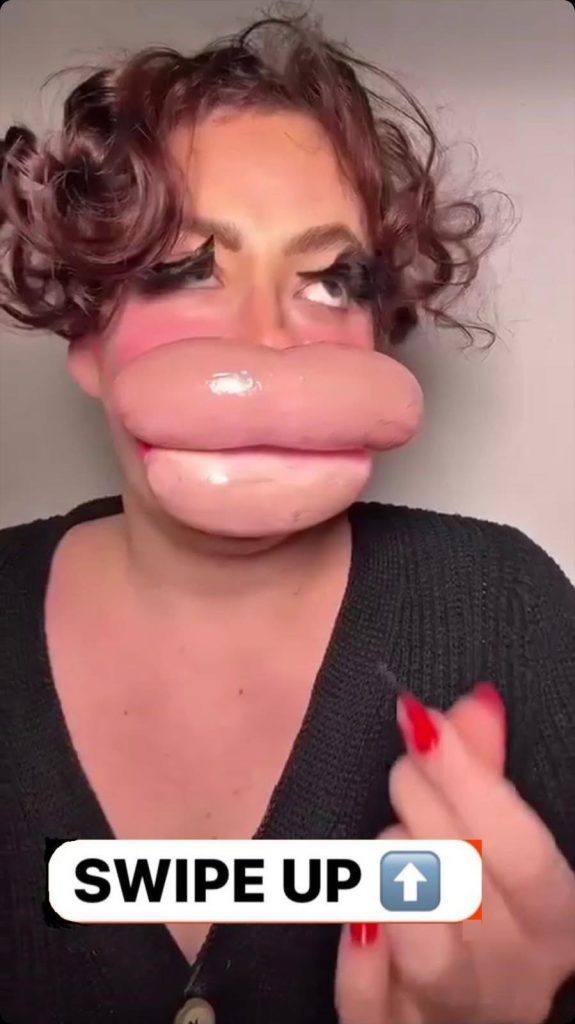
Andrea Ivanova’s name has become inseparable from visual shock and cultural debate, yet behind the headlines and viral images lies a story rooted in intent rather than impulse. The Bulgarian influencer, widely known as the woman with the “world’s biggest lips,” did not stumble into notoriety by accident. Her journey began in 2018 with a clear, self-defined goal: to reshape her appearance into an exaggerated, doll-like aesthetic inspired by Bratz figures, an aesthetic she believed represented her ideal self. At the time, her early procedures drew curiosity and skepticism, but few predicted the scale her transformation would eventually reach. Over the years, Andrea underwent repeated cosmetic enhancements, including extensive lip fillers, jawline sculpting, chin reshaping, and facial contouring that steadily pushed beyond conventional norms. What many perceived as extreme, she framed as deliberate artistry. Each procedure was a conscious step toward a vision she had imagined long before the world began watching. As attention grew, so did misunderstanding. Andrea was frequently portrayed as reckless or insecure, yet she consistently rejected those narratives, insisting her choices came not from self-loathing but from self-authorship. To her, transformation was not a rebellion against beauty standards, but a declaration that she alone would define them for herself.
As her appearance evolved, so did her digital presence, turning her personal journey into a global spectacle. Social media platforms became both her gallery and her megaphone, documenting each change and amplifying public reaction. Thousands followed her not only to witness physical alterations but to decode the motivation behind them. For supporters, Andrea emerged as a symbol of radical autonomy, someone unafraid to challenge deeply ingrained expectations of femininity and attractiveness. She embodied the belief that personal freedom includes the right to look however one chooses, regardless of public discomfort. For critics, however, her rise highlighted what they see as the troubling side of influencer culture, where extremity drives engagement and visibility becomes currency. Reports of the substantial sums she has spent on cosmetic procedures fueled further debate, yet Andrea never described her investments as losses or indulgences. Instead, she spoke of them as necessary commitments to self-realization. In her view, identity is not static but constructed, and her face is simply the medium through which that construction becomes visible. This philosophy resonated strongly with some audiences, while deeply unsettling others, revealing how sharply divided public opinion becomes when bodily autonomy collides with collective norms.
The announcement of Andrea’s latest ambition—to achieve what she calls the world’s largest cheekbones—has reignited controversy on an even broader scale. Unlike previous milestones, this new goal has drawn heightened concern from medical professionals who warn that repeated filler use, particularly at extreme levels, carries escalating risks. Doctors have publicly cautioned about potential complications, including compromised blood flow, tissue necrosis, chronic inflammation, infections, and permanent facial damage that may not be correctable. These warnings are not abstract hypotheticals but well-documented medical realities within cosmetic practice. Andrea does not dismiss these risks outright; instead, she acknowledges them while maintaining that informed consent grants her the right to proceed. She argues that awareness does not obligate retreat, and that choosing to accept risk is itself an expression of autonomy. For her, the pursuit of cheekbones is not a reckless leap but a continuation of a path she has walked knowingly for years. The tension between medical advice and personal determination has turned her into a focal point for debates that extend far beyond her own face.
At the heart of the controversy lies a difficult ethical question: where should the boundary between patient autonomy and medical responsibility be drawn? Cosmetic practitioners are trained to balance client desires with safety and ethical standards, yet Andrea’s case challenges those boundaries. She asserts that no external authority—medical, social, or moral—should override her consent as a capable adult. Critics counter that consent alone does not absolve professionals of responsibility, especially when procedures may cause lasting harm. This clash has transformed Andrea into a living case study in bioethics, forcing uncomfortable questions into public discourse. Should doctors refuse services they believe cross ethical lines, even when patients insist? Does denying treatment protect individuals, or does it undermine autonomy? Andrea’s unwavering stance has polarized audiences, with some praising her as a defender of bodily rights and others accusing her of normalizing dangerous extremes. What makes the debate particularly complex is that Andrea does not frame herself as a victim or a cautionary tale. She speaks with confidence, clarity, and consistency, challenging assumptions that extreme modification must stem from psychological distress or external pressure.
Beyond medicine and ethics, Andrea Ivanova’s transformation underscores the immense influence of social media in shaping modern identity. Digital platforms reward distinctiveness, pushing creators toward increasingly eye-catching expressions in order to remain visible. Andrea’s appearance guarantees attention, ensuring that every new change becomes news, commentary, and content. Critics argue this dynamic creates a feedback loop, where validation incentivizes further extremes, blurring the line between personal desire and performative escalation. Supporters reject this interpretation, insisting that visibility does not invalidate sincerity. They point out that Andrea’s aesthetic goals predate her online fame and would exist regardless of algorithms or engagement metrics. Andrea herself resists framing her choices as reactions to audience demand, maintaining that her vision is internal and enduring. Still, the reality of her influence cannot be ignored. Her image circulates globally, shaping conversations about beauty, normalcy, and the limits of self-expression in ways few traditional figures ever could.
Ultimately, Andrea Ivanova’s ongoing transformation is about far more than lips or cheekbones; it is a challenge to collective comfort zones around appearance, agency, and control. Her story forces society to confront its own contradictions: celebrating individuality while recoiling when individuality becomes unsettling. Whether viewed as empowering, alarming, or both, Andrea’s journey compels reflection on how much freedom individuals truly have to define themselves without approval. As she continues pursuing her evolving ideal, the debates surrounding her will only intensify, touching on health, ethics, media responsibility, and the psychology of transformation. Andrea appears undeterred by the scrutiny. For her, fulfillment lies not in validation but in alignment with her own vision. In that sense, her story transcends cosmetic extremes and becomes a mirror reflecting humanity’s enduring desire to shape identity on its own terms, even when the world watching struggles to understand it.