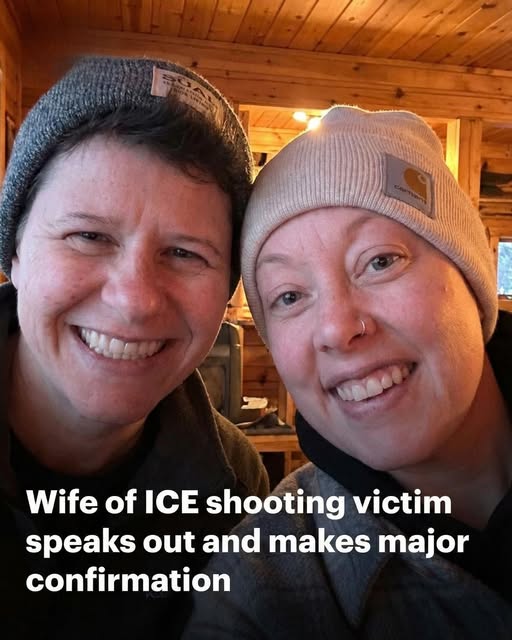
In the quiet residential streets of south Minneapolis on January 7, 2026, a morning that began with everyday routines and neighborhood concern ended in tragedy when Renee Nicole Good, a 37-year-old wife, mother, poet, and community member, was fatally shot by an ICE (Immigration and Customs Enforcement) agent during a federal enforcement operation. The incident has since reverberated across the city, across the nation, and across conversations about how law enforcement engages with civilians in highly charged circumstances. Good’s wife, Rebecca Good, shared that the couple had paused their day not in anger or confrontation, but out of concern for neighbors and community members who were observing and documenting the ongoing federal operation. Rebecca described their intention as nonviolent and rooted in solidarity, symbolized by the whistles they carried — a stark contrast, she said, to the guns wielded by agents at the scene. Her vivid statement, “We had whistles. They had guns,” crystallized for many the sense of imbalance and confusion that surrounded the encounter. Federal officials have offered a different explanation. According to statements from the Department of Homeland Security and ICE, officers fired on Good’s vehicle because they perceived an “immediate safety risk” when she attempted to drive away as they approached her SUV. ICE has characterized the situation as a defensive action, asserting that the vehicle posed a danger to officers. These claims have become central to the ongoing investigation and the broader public debate. Body-camera and bystander footage circulated widely online show Good’s SUV stationary in the street, agents approaching, and then an agent firing multiple shots as the vehicle began to pull away. Local authorities, including Minneapolis police and the FBI, have been involved in reviewing the evidence, and questions have arisen over agency coordination, training, and use-of-force policies. Despite official narratives, many witnesses and community members have disputed the idea that Good posed an imminent threat. Local reports describe her as stationary or attempting to move around federal vehicles rather than charging at officers. A number of eyewitness accounts and independent analysis of videos shared on social media suggest that the sequence of events does not clearly show aggressive intent on her part, spurring further public scrutiny of law enforcement decision-making. Human Rights Watch and other rights organizations have condemned the shooting, urging a transparent investigation and criticizing the escalation of federal enforcement presence in residential areas. These groups describe the incident as part of a pattern in which the use of lethal force raises serious human rights and civil liberties concerns. For those who knew Renee, the tragic outcome is far removed from her character and values. Friends and family have spoken of her as a joyful, compassionate, creative person committed to her faith, her community, and raising her children with love and dignity. Her writing, poetry awards, and community engagement reflect a life shaped by connection and care rather than confrontation. Rebecca Good has emphasized that reducing Renee’s identity to the circumstances of her death risks erasing the fullness of her life — her laughter, her tenderness as a parent, and her integrity. Many who gathered for vigils and memorials have echoed this sentiment, honoring her memory while also calling for accountability and review of enforcement practices that put civilians at risk. The public response has extended beyond Minneapolis. Vigils, protests, and demonstrations have taken place in cities nationwide, with advocates demanding accountability, a halt to aggressive immigration enforcement tactics, and safeguards for unarmed civilians. Debate among political leaders has been intense, with some defending law enforcement’s actions and others strongly criticizing them as unjustified. President Trump and administration officials have repeated claims that Good’s actions represented a threat, even suggesting involvement with organized agitation despite no verified evidence to support such assertions. Critics have labeled these claims as politically motivated and unsubstantiated, pointing out that spontaneous protests and expressions of grief are normal public reactions to such tragedies. Amid national controversy, Good’s family has requested privacy alongside respect and humanity. They seek to honor her life and values while the investigation proceeds, stressing that compassion and nuance are vital in understanding what happened. The questions raised by this incident — about law enforcement authority, community engagement, and how easily ordinary interaction can escalate into irreversible outcomes — have already ignited serious discussions at local and federal levels. What remains indisputable is the loss of a life, the grief of loved ones, and a community and nation left grappling with how to reconcile fear, authority, and the human cost of a moment when two very different worlds collided.