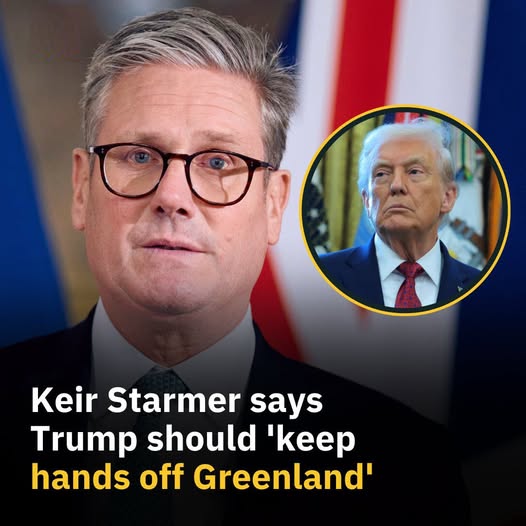
Diplomatic tensions over Greenland’s future have risen sharply in recent weeks as U.S. President Donald Trump repeatedly suggested the United States needs control of the Arctic territory for national security reasons. Trump, who has argued that Greenland’s strategic location is vital to U.S. defense interests, has made public comments and social media posts about acquiring or exerting stronger influence over the island—a semi-autonomous region of the Kingdom of Denmark. His remarks have drawn strong pushback not only from Danish and Greenlandic leaders, but also from European allies who stress the island’s right to self-determination and international legal norms. In response to Trump’s statements, British Prime Minister Keir Starmer has made clear that the future of Greenland should be decided only by Greenland and Denmark themselves. Pressed by the BBC and other broadcasters on whether he would tell Trump to “keep his hands off Greenland,” Starmer responded affirmatively, emphasizing that the Arctic island’s future should lie solely with its own people and the Danish government. He reiterated that Denmark remains a close European and NATO ally, and that decisions about Greenland’s status and governance should not be made by outside powers. Starmer’s stance comes amid strong objections from both Danish and Greenlandic leaders, who have publicly rejected any notion of U.S. annexation or external control. Denmark’s Prime Minister Mette Frederiksen has stated that it “makes absolutely no sense” to talk about the United States taking over Greenland and stressed that America has no right to annex any part of the Kingdom of Denmark. Similar sentiments were echoed by Greenland’s political leaders, who declared that they do not want to become Americans and insist that the future of their homeland be decided by Greenlanders themselves. The controversy has been fueled further by renewed geopolitical tensions in the region. Trump’s comments were made in the context of broader U.S. strategic concerns involving Russia and China, with the U.S. president arguing that controlling Greenland would help deter rival powers in the Arctic. His remarks suggested that if the territory could not be acquired “the easy way,” other measures might be considered—a phrasing that alarmed many observers and spurred diplomatic pushback from European capitals. Across Europe, leaders have echoed the message that sovereignty and territorial integrity must be respected, and that Greenland’s future belongs to its own people and to Denmark. The debate has underscored broader concerns about international law, alliance cohesion, and the importance of consultation and consent in decisions affecting indigenous populations and self-governing regions. European nations, including those in NATO, have reiterated that moves to alter Greenland’s status without Greenlandic and Danish agreement would undermine long-standing partnerships and the principles that underpin the post-World War II international order. For its part, public sentiment within Greenland remains firmly against any form of annexation or sudden change in governance. Polls and statements from Greenland’s leaders consistently show overwhelming support for maintaining autonomy and resisting external pressures. Many residents and political figures have framed the issue not only in terms of geopolitics, but also as an assertion of cultural identity and self-determination, insisting that Greenland’s destiny should be shaped internally and peacefully, without interference from foreign governments. In sum, Starmer’s comments reflect broader European resistance to U.S. ambitions regarding Greenland and a shared commitment among allies that the island’s future should be determined through dialogue among its own people, Denmark, and international partners—not imposed from outside. As diplomatic discussions continue, the situation highlights the complex interplay of strategic interests, alliance relationships, and respect for the rights of indigenous and self-governing territories in an increasingly geopolitically significant Arctic.