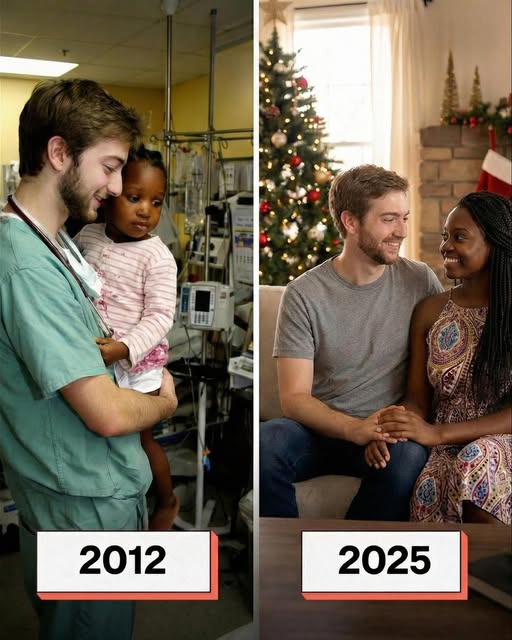
Thirteen years ago, my life changed during a night I believed would pass like so many others before it. I was a young doctor working an overnight shift, exhausted in the way only hospitals can make you—physically alert but emotionally numb. Near dawn, an ambulance arrived carrying a three-year-old girl who had survived a car accident that killed both of her parents. She was small, silent, and clung to the edge of the gurney as if letting go would erase her entirely. While nurses and social workers moved around her, she watched every face with terrified focus. When her injuries were ruled minor and the paperwork began, I found myself lingering. I brought her juice, sat beside her bed, and eventually read her a story from a worn children’s book someone had left behind. She fell asleep holding my finger. When social services explained that no relatives could be reached and that she would be placed in temporary care, the idea of her waking up alone felt unbearable. Without a grand plan or heroic impulse, I asked if I could take her home for the night. One night turned into several. Several became weeks. And somewhere between bedtime routines and cautious laughter, the temporary arrangement quietly became permanent. I adopted Avery not because I set out to become a single father, but because leaving her felt like a betrayal neither of us could survive.
Raising Avery reshaped everything I thought I knew about myself. My career changed first. I moved away from unpredictable hospital shifts and into a role that allowed for regular hours, even though it meant less prestige and lower pay. Our life was simple, sometimes uncomfortably so. I learned how to pack lunches, braid hair badly, and attend school meetings where I was often the only parent without a partner beside him. Avery never asked why her family looked different from others. She accepted our life with quiet trust. We built routines that anchored us—Saturday pancakes, homework at the kitchen table, nightly check-ins that sometimes turned into long conversations about fears, dreams, and questions neither of us could fully answer. There were moments of doubt, especially when she was younger and asked about her parents, but we navigated them together, with honesty and care. Over time, she grew into a thoughtful, determined teenager with a sharp sense of right and wrong. For years, it was just the two of us. And despite the sacrifices, it felt complete. Love, I learned, is not loud or dramatic. It is showing up, again and again, especially when no one is watching.
Last year, for the first time in a long while, I allowed myself to imagine expanding our small world. I entered a serious relationship, cautious but hopeful. My girlfriend appeared supportive, patient with my priorities, respectful of the bond between Avery and me. Avery was polite but reserved, which I attributed to normal teenage skepticism. For a time, everything seemed stable. Then one evening, my girlfriend approached me with concern etched into her face. She showed me footage from a security camera, pointing out that money was missing from my safe. She hesitated before saying what she clearly wanted me to believe—that Avery had taken it. The suggestion felt wrong immediately, like a misaligned bone. Avery had never lied to me, never given me reason to doubt her integrity. Still, doubt has a way of creeping in when planted by someone you trust. When I spoke to Avery, she looked genuinely confused and hurt. She mentioned something small, almost incidental: one of her hoodies had gone missing. That detail lingered with me longer than the accusation itself.
Unable to shake the unease, I reviewed additional footage myself, watching carefully, frame by frame. The truth revealed itself slowly and then all at once. My girlfriend had staged the theft, using Avery’s missing hoodie to disguise herself and redirect suspicion. Worse than the act itself was what followed. When confronted, she dismissed Avery coldly, referring to her as “not really my daughter,” as if thirteen years of shared life could be erased with a sentence. The betrayal landed hard, not just as a violation of trust, but as an attack on the foundation of our family. I ended the relationship immediately and reported the theft without hesitation. But the most important moment came afterward, sitting across from Avery at our kitchen table. I apologized to her, openly and without qualification, for allowing doubt to enter my mind at all. I told her what she already knew in her bones, but deserved to hear clearly: she was my daughter in every way that mattered, chosen not by circumstance, but by commitment.
The days that followed were quieter, heavier, but also clarifying. Avery processed everything with a maturity that both humbled and saddened me. She admitted that she had sensed something was wrong, that the way my girlfriend spoke about our family had made her feel invisible. Hearing that cut deeper than the theft itself. I realized how fragile safety can be, how easily it can be threatened not by strangers, but by those invited inside. Together, we talked through what had happened, not to dwell on blame, but to restore trust. I reminded her that family is not something proven through paperwork or DNA, but through consistency, protection, and presence. Thirteen years earlier, I had promised a frightened little girl that she would not be left alone again. That promise did not expire when life became complicated. It demanded renewal, especially then.
Looking back, the discovery that changed everything did more than expose a betrayal. It reaffirmed a truth I had lived for over a decade, sometimes without naming it. Parenthood is not defined by origin stories, but by daily choices. By staying when leaving would be easier. By believing your child when the world casts doubt. Avery is not an extension of my past, but a central part of my future. We continue forward now with a deeper understanding of each other and a bond tested, but ultimately strengthened. We thought we knew our story, but that moment revealed its true core. It was never about rescue or sacrifice. It was about love that shows up, defends fiercely, and remains unshaken when challenged. Thirteen years ago, I chose not to walk away. Today, I make that same choice, deliberately and without regret.