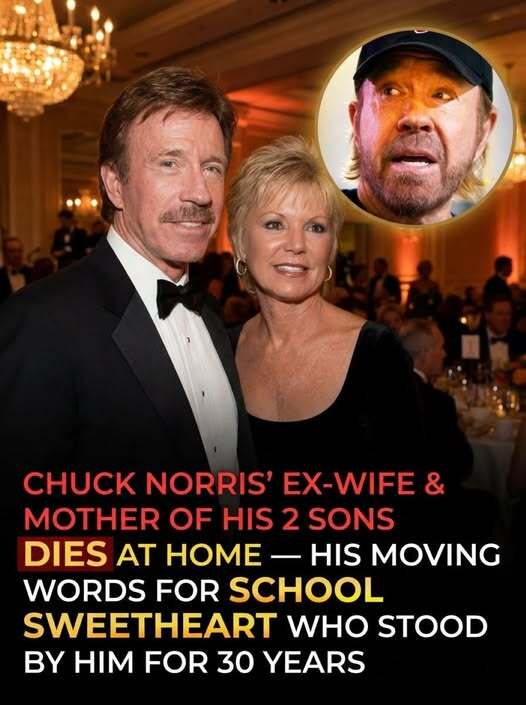
He was just eighteen when he made a choice that would quietly shape the emotional architecture of his entire life. Long before Chuck Norris became a household name, before martial arts titles, Hollywood stardom, or a pop-culture legacy that turned him into a near-mythical figure, there was simply a young man and his high school sweetheart, Dianne Holechek. They married in 1958, when neither fame nor fortune offered reassurance, only hope and determination. Their union was formed in a time of uncertainty, when adulthood arrived quickly and expectations were heavy. Dianne believed in him when belief required sacrifice, not applause. She knew him before discipline became legend, before resilience became branding, before his name carried weight beyond personal identity. Their early years were marked by ordinary struggles—financial pressure, long hours, military service, and the slow construction of a shared life. Fame was not part of the equation. What existed instead was partnership, patience, and the unspoken understanding that dreams often demand more from those standing nearby than from the dreamers themselves.
As the years unfolded, their marriage expanded to include children, responsibility, and the relentless demands of ambition. Together they raised two sons, Mike and Eric, while Chuck pursued martial arts mastery and later transitioned into acting. Dianne became the stabilizing force behind the scenes, managing home life while his career required travel, discipline, and emotional distance. Success did not arrive cleanly or without cost. With recognition came strain, and with strain came personal complications that tested the limits of their relationship. During their marriage, Chuck fathered a child outside the union—a revelation that could have destroyed many families publicly and irreparably. Instead, what followed was not spectacle, but restraint. There were no tabloid exposés, no dramatic confrontations played out for public consumption. Their marriage eventually ended after nearly thirty years, not with bitterness, but with quiet acknowledgment that love can change shape without vanishing entirely. Divorce did not erase their shared history, nor did it turn affection into hostility. It simply marked a transition, not a rejection, of everything they had been to one another.
What followed their separation revealed perhaps the most telling truth about their bond. Unlike many former couples whose lives fracture completely after divorce, Chuck Norris and Dianne Holechek remained connected through mutual respect and shared memory. She was never treated as a discarded chapter of his past, nor reduced to a footnote in the story of his success. Friends and family observed that their relationship resembled something closer to lifelong companionship than estrangement. They communicated, supported their children together, and preserved a sense of family that outlasted legal definitions. Dianne knew Chuck before fame reshaped his identity, before public expectations demanded a persona larger than life. That knowledge created a connection immune to ego and resentment. She represented continuity in a life increasingly defined by public perception, reminding him—simply by existing—of who he had been before the world began watching.
As time passed, Chuck Norris’s public image grew larger while Dianne’s life became increasingly private. She did not seek attention, nor did she trade on proximity to fame. Instead, she lived quietly, grounded in family and personal dignity. In later years, she faced a long and difficult battle with dementia, a disease that slowly erodes memory while leaving emotional presence intact. Those close to her witnessed the painful paradox of someone forgetting names and moments while still carrying the essence of who they had always been. The illness unfolded gradually, marked by loss layered upon loss, and was handled with discretion and care. There were no public updates, no attempts to turn her struggle into narrative or inspiration. The focus remained on comfort, protection, and preserving her dignity—values that had defined her life long before illness entered the picture.
When Dianne Holechek passed away on December 21, 2025, at the age of eighty-four, the response reflected the nature of the bond she and Chuck had maintained for decades. There were no dramatic announcements, no performative grief. Chuck Norris honored her with simple, deeply personal words, acknowledging her as the mother of his children, his first great love, and a woman who had shaped his life in ways no amount of success could replace. The tribute was restrained, sincere, and absent of spectacle. It spoke not of regret or nostalgia, but of gratitude. Those who read his words recognized something rare: a man honoring a relationship not for how it appeared, but for what it had meant privately. Her death did not reopen old wounds—it closed a chapter that had defined his emotional foundation. She had known the version of him that existed before expectation, before legacy, before myth.
Their story does not fit neatly into familiar narratives about marriage, divorce, or love. It is not a fairy tale, nor a cautionary tale, nor a redemption arc designed for headlines. It is a story about longevity, complexity, forgiveness, and the quiet endurance of care. Chuck Norris and Dianne Holechek did not remain married forever, but they remained connected in ways that mattered deeply. Their bond demonstrates that relationships do not have to be perfect to be meaningful, and that respect can survive even when romance fades. In the end, what defined their relationship was not how it began or how it legally ended, but how it was carried forward with humanity and restraint. Some people know us before the world does, and when they are gone, they take with them a version of ourselves that no one else will ever truly know.