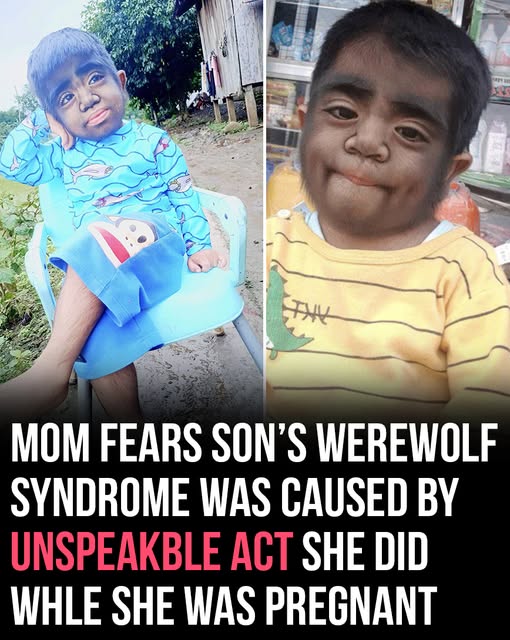
Alma Gamongan’s life changed the moment her son, Jaren, came into the world. Born in a remote mountain village in Apayao, Philippines, Jaren entered life with a full head of dark hair, striking black sideburns, and thick patches covering his face, neck, back, and arms—an appearance that immediately drew attention, curiosity, and concern. Doctors quickly identified his condition as hypertrichosis, an incredibly rare genetic disorder sometimes referred to as “werewolf syndrome,” which affects only one in a billion people. The initial shock was compounded by Alma’s own fears and guilt. She remembered her uncontrollable pregnancy cravings, particularly for wild cats, and the local superstitions that attributed a child’s unusual appearance to a mother’s actions. Alma’s worries were not eased by neighbors who suggested that Jaren’s striking looks could be the result of a curse or mystical forces, deepening her sense of responsibility and fear, despite the doctors’ reassurances that genetics alone were to blame.
Growing up with hypertrichosis presents unique challenges, not only medically but socially and emotionally. Historically, individuals with this condition were feared and misunderstood. In Europe, they were often called monsters or witches, displayed in freak shows, or ostracized from their communities. This treatment spanned centuries, affecting perceptions worldwide, where folklore, superstition, and fear of the unknown shaped the ways families and societies responded to children with abnormal hair growth. Alma’s experience, while modern, is a contemporary echo of these older fears. In the Philippines, where local beliefs and traditions hold sway, her guilt was heightened by the notion that her son’s appearance was a direct consequence of her actions during pregnancy. Doctors, however, clarified that hypertrichosis is purely genetic, either inherited or caused by spontaneous mutations. Jaren’s case is congenital, and while it is extraordinarily rare, it has nothing to do with the food Alma ate or any superstitions surrounding her pregnancy. Understanding this distinction became a critical turning point for Alma, allowing her to shift from self-blame toward practical care and acceptance.
Despite the rarity of his condition, Jaren is described as a playful, curious, and happy child. His personality shines through, providing a stark contrast to the unusual appearance that initially dominated perceptions of him. By the age of four, hair had grown extensively on his back, arms, and neck, prompting Alma to attempt trimming, but the hair returned thicker and faster, leaving her to manage it with careful bathing and skin care, especially in hot weather when rashes became uncomfortable. The physical management of hypertrichosis is only part of the challenge; social acceptance is another. Alma fears the potential bullying and discrimination her son might face as he grows older, worrying about school and the reactions of other children. Her concerns are shared by medical professionals and advocacy groups worldwide, highlighting the importance of community understanding and education to ensure that children with rare conditions are not marginalized or stigmatized for their differences.
Medical solutions for hypertrichosis remain limited but increasingly accessible. Laser hair removal is considered the most effective treatment to control excessive hair growth, though it requires multiple sessions over several weeks and can be financially burdensome. Dr. Ravelinda Soriano Perez, who examined Jaren, recommended a series of ten sessions over four to six weeks, costing approximately 2,500 Philippine pesos per session, an amount that can strain families in rural regions. Alma has sought help from her community and supporters to make this treatment possible, expressing gratitude for the assistance received and hope that Jaren’s life can be eased through proper medical intervention. Her determination to pursue care despite financial and logistical challenges demonstrates her commitment to her son’s well-being, emphasizing that love and advocacy are as critical as medical treatment in supporting children with rare conditions.
The story of Jaren Gamongan also serves as a window into the intersection of culture, superstition, and science. In communities like Alma’s, traditional beliefs still strongly influence how unusual events or physical differences are interpreted. The idea that a mother’s diet or actions could result in a child being born “cursed” or different reflects centuries-old folklore that persists even in the modern era. Alma’s initial guilt illustrates how powerful these beliefs can be, shaping emotions and parental decision-making. Modern medical science, by providing clear explanations and treatments, offers a counterbalance to these superstitions, helping families understand that rare conditions like hypertrichosis are the result of genetics and not mystical punishment. This reconciliation between cultural belief and scientific understanding is vital, as it allows families to move beyond guilt and fear toward practical solutions and emotional support.
Ultimately, Jaren’s story is one of resilience, love, and hope in the face of extraordinary circumstances. Hypertrichosis may be rare, striking, and socially challenging, but it does not define Jaren’s character or limit his potential. With his mother’s dedication, the support of his community, and access to medical care, he has the opportunity to grow up feeling valued, understood, and empowered. His uniqueness is part of a broader human tapestry, emphasizing the importance of empathy, awareness, and acceptance in society. Alma’s journey from fear and self-blame to advocacy and care illustrates the transformative power of understanding, education, and support. The narrative of Jaren and his mother stands as a testament to human resilience, the enduring strength of parental love, and the hope that even the rarest conditions can be met with dignity, compassion, and opportunity. In a world that often reacts with curiosity, fear, or misunderstanding, Jaren reminds us that being born different is not a curse but a unique gift that deserves nurturing, protection, and celebration.