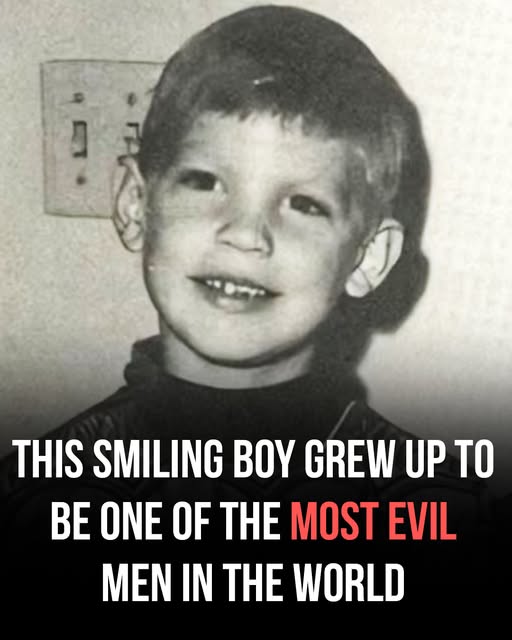
He began life in a way that revealed nothing of the darkness that would later define him. Childhood photographs show a thin, dark-haired boy with cautious eyes and a faint, almost apologetic smile, the kind of face that blends easily into classrooms and neighborhoods without drawing attention. Born in the American Southwest into a working-class family, Richard Ramirez appeared unremarkable to teachers and neighbors, quiet rather than disruptive, withdrawn rather than aggressive. He was often described as shy, observant, and emotionally distant, a child who seemed to absorb the world around him without fully participating in it. To casual observers, there was nothing alarming about his demeanor. Yet beneath that surface lay a growing sense of disconnection, shaped by an environment that offered little stability or emotional safety. Early development is when children learn trust, empathy, and boundaries, and for Ramirez those lessons were distorted or absent. What looked like introversion was, in part, a response to confusion and fear, a coping mechanism formed long before he could articulate pain or ask for help.
Inside the home, the atmosphere was far more chaotic than his outward appearance suggested. Family accounts later described a household marked by volatility, neglect, and exposure to disturbing behavior. Violence was not an abstract concept but something he witnessed firsthand, normalizing aggression at an age when the brain is still forming its understanding of right and wrong. Emotional support was inconsistent, and affection unreliable, creating an internal landscape shaped by insecurity and mistrust. Psychologists emphasize that chronic exposure to fear during childhood alters stress responses, affecting impulse control and emotional regulation well into adulthood. In Ramirez’s case, the home offered little refuge from anxiety, and school failed to provide a corrective balance. Rather than feeling protected by social structures, he drifted further inward, becoming increasingly isolated. These early years did not predetermine his future, but they laid a fragile foundation upon which later experiences would build, compounding harm rather than healing it.
As adolescence approached, instability intensified. Ramirez moved frequently and struggled to form lasting relationships, drifting through social spaces without roots or guidance. Substance abuse entered his life early, first as experimentation and then as escape, blurring emotional boundaries and dulling fear. Drugs became a way to manage inner chaos, but they also amplified aggression and distorted perception. Minor criminal behavior followed, reinforcing a cycle of risk and consequence that rarely included meaningful intervention. Experts later pointed to this period as critical, a time when warning signs were visible but largely unaddressed. Exposure to graphic violence, untreated psychological trauma, and substance abuse formed a volatile combination. Without consistent support systems, his worldview hardened, shaped by alienation and resentment. What might have been redirected through early mental-health intervention instead escalated unchecked, turning vulnerability into a dangerous sense of detachment from others.
By early adulthood, his behavior had shifted from erratic to predatory. Crimes escalated in severity, reflecting a deepening pattern of control, brutality, and indifference to human suffering. California communities were shaken as news spread of a serial offender striking at night, violating homes that people believed were safe. The terror was amplified by randomness; victims varied in age and background, creating a sense that no one was immune. The contrast between Ramirez’s childhood images and the figure described in police reports was jarring. This dissonance fueled public fascination and fear, reinforcing the uncomfortable truth that extreme violence can emerge from seemingly ordinary origins. Each crime added to a growing atmosphere of dread, altering how people slept, locked doors, and trusted their surroundings. The transformation from an overlooked boy to a symbol of terror underscored how cumulative trauma and unchecked pathology can manifest in devastating ways.
The name Richard Ramirez soon became inseparable from the moniker “Night Stalker,” a label that carried national weight. Media coverage intensified, amplifying fear while also scrutinizing his past for explanations. His eventual capture brought relief, yet it also reopened questions about missed opportunities for intervention. Investigators and psychologists dissected his history, identifying patterns of abuse, exposure to violence, and substance dependence, but explanations offered little comfort to victims and families. Ramirez’s trial and incarceration marked the formal end of his crimes, but not the end of their impact. Survivors carried lifelong trauma, neighborhoods remembered the nights defined by fear, and California’s collective memory absorbed another grim chapter. His decades in prison, ending with his death, closed the legal story but left moral and social questions unresolved.
Looking back, the life of Richard Ramirez stands as a chilling case study rather than a tale of inevitability. Childhood trauma does not doom a person to violence, yet unaddressed trauma combined with neglect, exposure to brutality, and lack of intervention can dramatically increase risk. His early photographs remain unsettling not because they predict evil, but because they remind us how ordinary vulnerability can be overlooked. Mental-health professionals consistently stress the importance of early support, stable environments, and attentive communities in preventing destructive paths. Ramirez’s legacy is not only the fear he inflicted, but the lesson embedded in his transformation: that ignoring warning signs and failing to protect vulnerable children can have consequences that ripple far beyond one life, shaping collective history through irreversible harm.