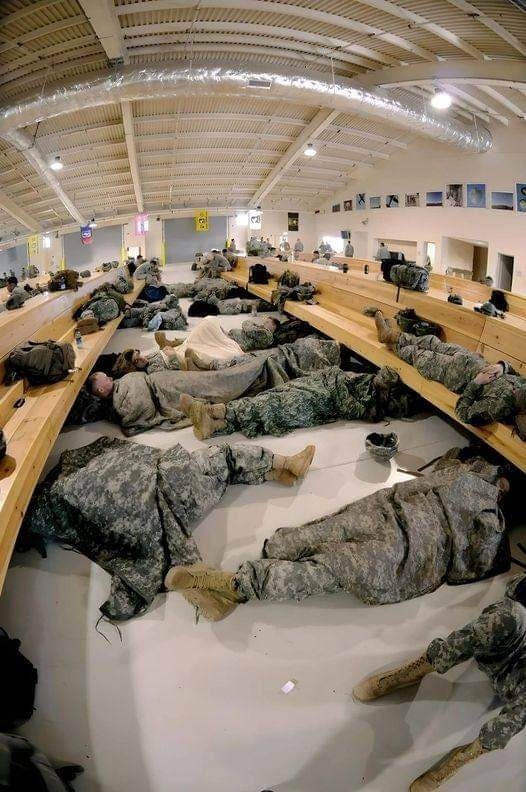
The photograph captures a scene rarely highlighted in glossy recruitment posters or cinematic war portrayals: dozens of U.S. Army soldiers sprawled across long wooden benches inside what appears to be a large hall or training facility, asleep in full uniform. Boots remain on, camouflage fatigues are rumpled, rucksacks are tucked under heads or pushed to the side, and bodies lie in every possible position that exhaustion allows. The ceiling arches high above them, industrial lights casting a soft glow over the room, while ventilation ducts snake along the roof, suggesting a converted drill hall, gymnasium, or temporary staging area. There is no sense of chaos, only deep fatigue. What stands out most is the vulnerability. These are trained soldiers—men and women accustomed to discipline, structure, and constant alertness—yet here they are, surrendered entirely to sleep wherever space allowed. The image is powerful because it shows the military not in motion or combat, but in stillness. It reminds the viewer that behind the uniform are human beings whose bodies eventually demand rest, no matter the mission or circumstances.
This photo speaks volumes about the reality of life in the U.S. Army, especially during training cycles, deployments, or large-scale mobilizations. Sleep deprivation is not an exception in military life; it is often the norm. Soldiers learn to rest whenever and wherever they can—on benches, floors, transport vehicles, or with their backs against walls. This adaptability is not accidental; it is a survival skill. The Army trains its personnel to function under extreme conditions, including limited sleep, because real-world missions rarely allow comfort. Yet this image also quietly raises questions about the cost of that reality. Fatigue affects reaction time, mental clarity, and emotional resilience, but soldiers are expected to push through regardless. The photo doesn’t criticize or glorify—it simply documents. It captures a moment when discipline gives way to biology, when even the strongest sense of duty cannot override the body’s need to shut down. In doing so, it humanizes an institution often viewed only through the lens of power and strategy.
What is especially striking is the sameness within the scene. Rank is invisible here. Officers and enlisted soldiers alike appear indistinguishable, reduced to tired bodies wrapped in the same camouflage pattern. The Army is hierarchical by design, but exhaustion is the great equalizer. In moments like this, status fades and shared experience takes over. Everyone in the room has likely endured long hours, heavy gear, strict schedules, and mental strain. The benches become communal resting places, and personal space becomes a luxury no one can afford. This shared hardship is one of the foundations of military cohesion. Bonds formed under exhaustion and stress often last a lifetime, because they are rooted in mutual endurance. The image subtly communicates that brotherhood and sisterhood are not only forged in combat, but also in these quieter, unphotographed moments when soldiers collapse together, trusting the environment—and each other—enough to sleep.
Beyond the immediate visual, the photo invites reflection on how the public perceives the U.S. Army. Popular culture often frames soldiers as either invincible heroes or distant instruments of policy. Rarely are they shown as ordinary people caught in between orders, waiting, resting, and recovering. This image challenges that narrow perception. It suggests that military readiness is not a constant state of action, but a cycle of exertion and recovery. Training, deployment preparation, humanitarian missions, disaster response—all involve long stretches of waiting punctuated by intense activity. In those in-between moments, soldiers rest where they can, because they must be ready when called. The Army’s effectiveness depends not only on weapons and strategy, but on the physical and mental resilience of its personnel. This photograph quietly underscores that reality without dramatization or commentary.
There is also an unspoken emotional layer to the image. For families of service members, scenes like this can be both reassuring and unsettling. Reassuring, because the soldiers are alive, together, and momentarily safe. Unsettling, because it reveals how taxing military life can be, even outside of combat zones. Sleeping fully clothed on hard benches is not a sign of comfort—it is a sign of necessity. It reminds us that service often involves long separations from home, disrupted routines, and physical strain that accumulates over time. The photo does not show fear or violence, but it does show weariness, which can be just as heavy. In this way, the image serves as a quiet appeal for understanding and empathy, not only for those who serve, but for the families who support them from afar.
Ultimately, this photograph tells a simple yet profound truth: the U.S. Army is made up of people. People who train hard, follow orders, shoulder responsibility, and accept sacrifices that most civilians will never experience firsthand. They are disciplined, capable, and prepared—but they are also human. They get tired. They sleep when they can. They lean on shared spaces and shared silence to recover enough strength to continue. By showing soldiers not in action but at rest, the image fills an important gap in how military life is understood. It doesn’t diminish their strength; it deepens it. It reminds us that resilience is not the absence of exhaustion, but the ability to rise again after it.