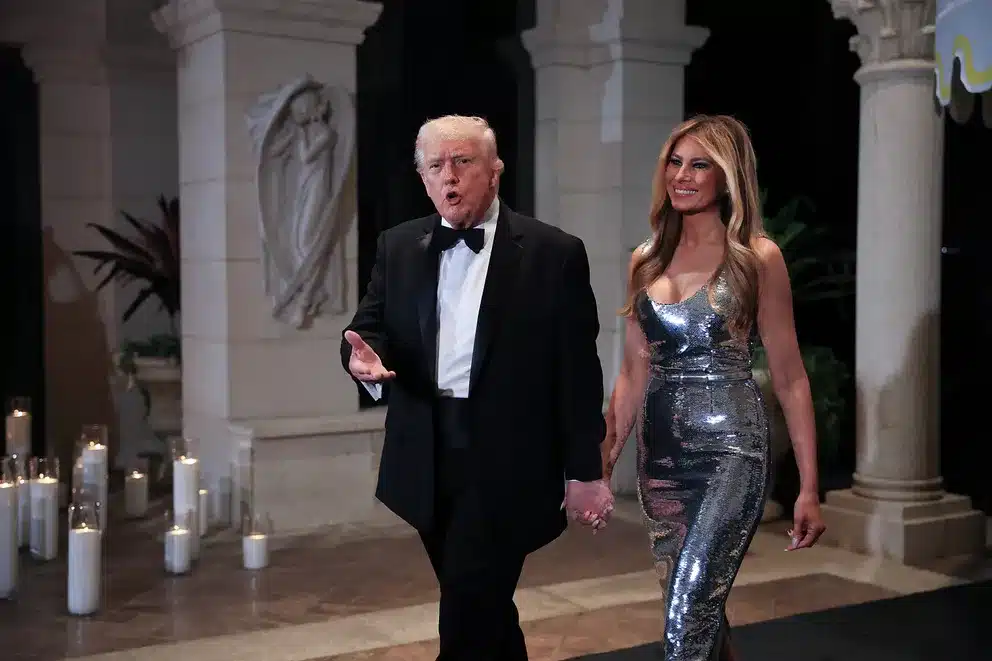
What was meant to be a familiar Mar-a-Lago tradition—an evening of fireworks, formal wear, political networking, and year-end spectacle—ultimately revolved around a single visual moment. When President Donald Trump and First Lady Melania Trump arrived at their New Year’s Eve 2025 celebration at the Mar-a-Lago Club in Palm Beach, cameras locked in instantly. The ballroom shimmered with chandeliers and anticipation, but it was Melania’s appearance that redirected attention almost immediately. Dressed in a sleeveless, silver, sequin-covered gown that reflected light with every movement, she embodied a high-glamour aesthetic unmistakably tailored for the final night of the year. The look was striking, deliberate, and unapologetically celebratory, ensuring that before midnight even approached, the night already had its defining image.
The gown itself was a study in modern eveningwear. Identified by multiple fashion outlets as the Manu Sequin maxi dress by The New Arrivals by Ilkyaz Ozel, the design emphasized a sculpted silhouette and a mirror-like metallic finish. Rather than competing with the dress, Melania’s styling remained restrained—minimal jewelry, polished makeup, and her signature loose waves framing her face. The effect was calculated simplicity, allowing the gown to command attention without distraction. On a night traditionally associated with excess, the balance between boldness and restraint felt intentional. It was not a costume, nor an attempt to shock, but a clear embrace of New Year’s Eve glamour at its most theatrical, signaling confidence and control over her public image.
As images and videos circulated online within minutes, social media reactions followed a familiar pattern: swift, polarized, and emotionally charged. Some critics focused on the gown’s high-shine finish, likening it mockingly to “tin foil” or “aluminum wrap,” transforming fashion commentary into viral shorthand. Others questioned whether such a look aligned with their personal expectations of how a First Lady should present herself, particularly at an event tied so closely to political identity. Comments labeling the dress “too nightclub” or “not appropriate” revealed less about the garment itself and more about the persistent tension between tradition and individuality in public-facing roles. The debate was not really about fabric or neckline, but about who gets to define propriety—and whether those definitions should evolve.
At the same time, praise arrived just as quickly. Supporters framed the gown as perfectly aligned with the spirit of the evening: festive, confident, and unapologetically stylish. To them, the criticism felt outdated, rooted in narrow ideas of decorum that ignore context. New Year’s Eve, after all, is a night designed for visual impact, celebration, and symbolic transition. In that framing, Melania’s look was not a misstep but a success—precisely because it dominated attention. Parallel to the fashion debate, another familiar strand of online speculation emerged, with commenters suggesting that Melania looked “different,” though few could articulate why. Such remarks echoed a long-standing pattern of scrutiny applied to her appearance, where even subtle changes invite commentary, reinforcing how closely her image is monitored and dissected.
Inside the Mar-a-Lago ballroom, however, the evening moved forward largely untouched by online noise. The guest list reflected the event’s unique blend of politics, power, and exclusivity, with high-profile figures circulating as 2026 approached. Pool reports noted the presence of longtime political allies and international figures, underscoring how the celebration functioned not just as a party, but as a networking hub. As midnight neared, President Trump delivered a brief New Year’s message—“Peace on earth”—a line that contrasted sharply with the visual extravagance surrounding it. The juxtaposition felt characteristic of the event itself, where simplicity of language often exists alongside carefully staged spectacle.
The night’s final act pushed that spectacle even further. According to pool coverage, guests watched a live painting performance in which an artist created a large depiction of Jesus in real time, blending performance art, religious imagery, and audience participation. The completed piece was then auctioned for a reported $2.75 million, a figure that became its own headline. The moment encapsulated the Mar-a-Lago New Year’s Eve formula: politics, faith, wealth, and showmanship intersecting in a single, highly choreographed scene. In that context, Melania’s gown felt less like an outlier and more like a visual anchor—one element in a broader production designed to be seen, discussed, and remembered.
In the end, the reaction to Melania Trump’s silver sequin gown says as much about the audience as it does about the outfit. Love it or criticize it, the look succeeded in becoming the visual symbol of the night, overshadowing guest lists, speeches, and even multimillion-dollar moments. It reaffirmed a reality that defines modern public life: image travels faster than substance, and a single photograph can dominate the narrative more effectively than any prepared message. As fireworks faded and 2026 began, the takeaway was unmistakable. In an era shaped by instant reaction and endless commentary, a well-timed, high-impact appearance can still command attention—and Melania Trump, once again, understood exactly how that works.