I did not walk into that evening expecting anything unusual to happen.
That is how most ordinary days begin, after all. Not with anticipation, not with suspicion, but with the quiet assumption that everything will continue exactly as it has before.
Work had drained me in the slow, familiar way it always did. Nothing dramatic, nothing catastrophic—just an accumulation of small pressures that build up like dust in the corners of the mind.
A meeting that should have lasted twenty minutes stretched into an hour.
A string of emails demanded replies that I no longer had the energy to phrase politely.
A task I thought was finished returned unexpectedly with corrections.
By the time I left the office, my thoughts felt crowded, as if every decision I had made that day had left a faint echo behind it.
The commute home did not help.
Traffic moved like it had forgotten why it was supposed to move at all. Cars inched forward, paused, then inched again, as if the entire city had collectively agreed to test everyone’s patience at once.
When I finally reached my apartment building, I felt a kind of relief that was almost physical.
Not happiness. Not peace.
Just the absence of motion.
The elevator ride upward was silent except for the faint mechanical hum. I stared at the doors, waiting for them to open as though they might reveal something different this time. They never did.
Inside my apartment, everything was exactly as I had left it.
Shoes by the entrance.
A jacket draped over the chair.
A faint smell of air that had not been disturbed all day.
Ordinarily, this kind of stillness would have comforted me. That evening, it felt heavier than usual, like the air itself had settled into place and refused to move.
I set my keys down in their usual bowl. The sound was sharper than expected in the quiet.
For a few minutes, I moved through routine without thinking. Wash hands. Change clothes. Drink water. Check messages I did not care about.
The world outside continued without me, and I let it.
Eventually, I made my way toward the bedroom.
That was when everything shifted.
At first, I did not notice anything wrong. The room looked like it always did in the evening—dim, softened by the weak glow of a bedside lamp I often forgot to replace.
But then my eyes caught something that did not belong.
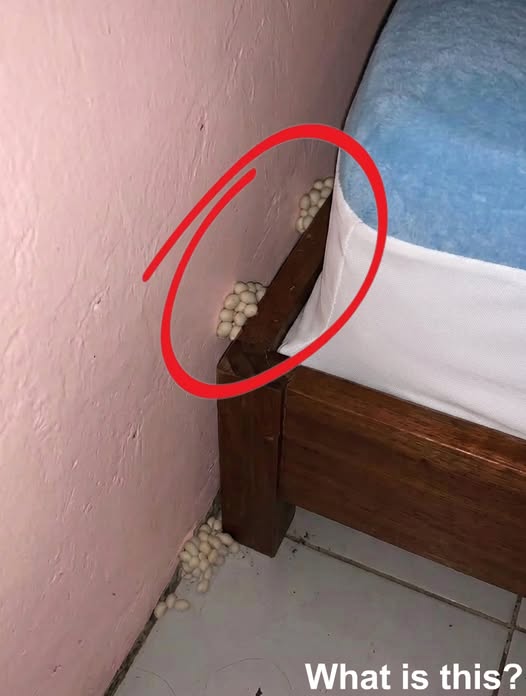
A small cluster near the edge of the bed.
Still. Pale. Unmoving.
At first, it was only a suggestion of shape, like the way your mind fills in details before your eyes fully understand what they are seeing.
I paused.
That pause lasted longer than it should have.
Because in that moment, my imagination arrived before my reasoning did.
And imagination is rarely kind when it is left unsupervised.
I stepped closer, slowly, as though speed might change what I would find.
The shapes became clearer.
Small rounded forms. Grouped tightly. Pressed against the wall where the bedframe met the corner.
My throat tightened without permission.
I did not know what I was looking at, but my mind was already trying to decide what it could be. And the possibilities it offered were not comforting.
Insects. Nesting. Something decaying. Something spreading.
I crouched slightly, not fully committing to closeness, as if distance alone could protect me from consequences.
The bedroom suddenly felt unfamiliar. The same furniture, the same walls—but reinterpreted through suspicion.
I reached for my phone and turned on the flashlight.
The beam cut sharply through the dim air.
What I saw made my stomach tighten further.
The shapes looked more defined now. Smooth. Clustered. Delicate, but in a way that my tired mind did not yet know how to interpret correctly.
I had seen enough warning images online over the years—too many articles, too many cautionary posts—to associate unknown clusters with danger first and explanation second.
My thoughts raced ahead of evidence.
And yet nothing moved.
Nothing reacted.
There was no sound, no expansion, no sign of life in motion.
Only stillness.
That contradiction unsettled me more than anything else.
Because danger, at least, is usually willing to announce itself.
Minutes passed. Or maybe only seconds stretched incorrectly by anxiety.
I kept staring, trying to force meaning out of silence.
And slowly, something began to change.
Not in the object.
In me.
The longer I looked, the less threatening the cluster appeared. Fear depends heavily on ambiguity, and ambiguity fades when attention lingers long enough.
I leaned closer.
Carefully.
The light revealed textures I had missed before.
Thin, shell-like surfaces. Subtle coloration. Natural irregularities that did not match anything artificial or harmful.
A thought surfaced quietly, almost hesitant.
What if I am wrong?
That question changed everything.
I opened my phone and searched.
Within moments, images appeared that matched what I was seeing almost exactly.
The tension in my body released so quickly it almost felt like collapse.
Lizard eggs.
Not an infestation. Not a threat. Not a problem spiraling out of control.
Just life.
Quiet. Hidden. Unremarkable at first glance, until understood.
I sat back without realizing I had been holding my breath.
A laugh escaped me, unexpected and slightly disbelieving.
All that fear. All that anticipation of something terrible.
And the reality was so simple it almost felt absurd.
Relief came in waves after that—first shock, then release, then a kind of embarrassed amusement at how quickly my mind had constructed disaster from nothing solid.
I looked again at the eggs.
They had not changed.
Only my understanding had.
And that difference felt strangely profound.
It made me think about how often the mind writes stories before it checks the facts. How quickly silence becomes danger. How easily the unfamiliar becomes threatening simply because it is not yet named.
I found myself curious now, not afraid.
Curious about how they got there. Curious about how long they had been hidden. Curious about the small creature that had chosen this place without my awareness.
Somewhere outside my apartment, life had continued unnoticed enough to leave a trace inside my own room.
That realization shifted something deeper than the initial fear.
It made the world feel less contained than I had assumed.
I carefully researched further, learning more about how fragile such eggs could be, how sensitive they were to temperature and movement. What had moments ago felt like a “problem” now felt like responsibility.
I did not want to harm them.
But I also did not want to leave them in a place where they might accidentally be damaged.
The decision formed slowly, not from panic, but from caution.
I gathered a small container and lined it with soft soil. Every movement felt deliberate, as if speed itself might disrupt something invisible and important.
When I finally returned to the corner beside the bed, I noticed something else entirely.
Not fear.
Respect.
Not because the eggs demanded it, but because they represented something quietly persistent. Life does not announce itself loudly in most cases. It hides, it waits, it adapts.
I carefully transferred them.
Nothing dramatic happened. No reaction. No sign of awareness.
Just stillness continuing.
I carried the container outside into the night.
The air felt cooler than inside. The sky above the city was dark but open, scattered with faint light.
For a moment, I stood in the garden unsure of what exactly I was doing. I was not rescuing something from danger. I was not saving the world from disaster.
I was simply placing life back into a more suitable environment.
That simplicity felt grounding.
I chose a sheltered spot beneath shrubs, where the soil was undisturbed and the light was soft.
When I set the container down, I paused longer than necessary.
Not because anything needed to happen, but because I felt something inside me settling.
The kind of quiet understanding that does not arrive with explanation, but with experience.
I realized how easily fear had filled the gap left by ignorance.
And how quickly that fear had disappeared once understanding arrived.
The object had not changed at all.
Only my interpretation had shifted.
That distinction stayed with me longer than I expected.
Because it applied to more than just that moment.
It applied to almost everything.
The unknown is rarely dangerous by default. It is simply unfinished information. And the mind, uncomfortable with unfinished information, often completes it with worst-case possibilities.
I stayed outside for a while, letting the night air cool the remnants of tension still in my body.
Then I returned inside.
The apartment felt different now, though nothing had changed. The bedroom corner where I had first seen the cluster looked empty, but no longer unsettling.
It had become ordinary again.
And that ordinariness felt like peace.
Sleep came slowly that night.
Not because I was disturbed, but because I was thinking.
Thinking about how many times in life I had mistaken uncertainty for danger. How often I had assumed meaning before evidence. How frequently fear had arrived first, only to be corrected later by reality.
The memory of those small eggs lingered in my mind—not because they were extraordinary, but because they were not.
They were simply life, continuing quietly without asking permission to exist.
The next morning, I checked the garden before leaving.
Everything remained as I had left it.
No disturbance. No change.
Just continuation.
And somehow, that felt like the right outcome.
As I left for work, I carried a different awareness with me.
Not dramatic enlightenment. Not sudden transformation.
Just a quieter understanding that not everything unfamiliar is dangerous, and not every moment of uncertainty deserves panic.
Sometimes the mind creates storms where there is only stillness.
And sometimes, hidden in the places we least expect, what we mistake for fear is simply life waiting patiently to be understood.