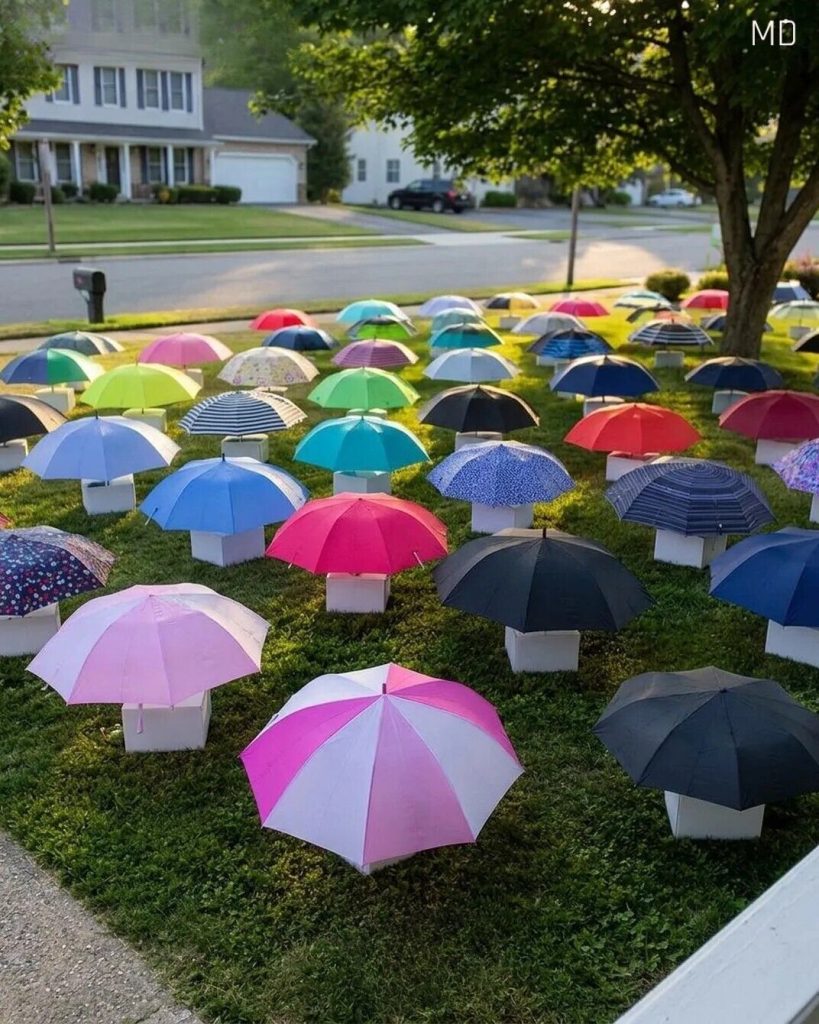
The morning I opened my front door and discovered forty-seven umbrellas spread across my lawn, I genuinely believed I was still asleep.
The sight made no sense.
Large umbrellas. Small umbrellas. Bright red umbrellas. Plain black umbrellas. Children’s umbrellas decorated with cartoon characters. Elegant umbrellas with curved wooden handles. Every one of them stood open across the grass like a colorful field of flowers that had appeared overnight.
For several seconds, I simply stared.
Then I noticed the boxes.
There was one beneath each umbrella.
Forty-seven boxes.
Forty-seven handwritten numbers.
And dozens of neighbors gathered along the sidewalk watching quietly.
My coffee cup nearly slipped from my hand.
“Eli!” I called.
My twelve-year-old son appeared behind me, still wearing his pajamas.
“What happened?” he asked.
“I was hoping you could tell me.”
His eyes widened.
“Whoa.”
That was the only word either of us managed for a moment.
Because neither of us understood that we were looking at the result of a single decision made three days earlier.
A decision involving one blue umbrella.
And one stranger standing alone in the rain.
Three years before that morning, my husband, Michael, died unexpectedly.
Some losses arrive like storms.
Others arrive like silence.
His was both.
One day he was laughing at breakfast and teasing Eli about leaving cereal bowls in strange places.
The next day he was gone.
No warning.
No preparation.
No chance for goodbye.
People tell you grief gets easier with time.
I don’t know if that’s true.
I think grief simply changes shape.
At first, it feels impossible to survive.
Then eventually it becomes something you carry.
Some days it’s heavy.
Some days it’s light.
But it never truly leaves.
For Eli, the hardest part wasn’t losing his father.
It was fearing he might forget him.
Children worry about things adults rarely consider.
He worried that one day he wouldn’t remember his father’s voice.
Or laugh.
Or the way he smelled after working in the garden.
So he held tightly to anything connected to Michael.
Old photographs.
A baseball glove.
A faded coffee mug.
And one particular blue umbrella.
It wasn’t expensive.
It wasn’t special.
At least not to anyone else.
Michael had purchased it during a family trip years earlier when we got caught in an unexpected storm.
The umbrella became one of those ordinary objects that somehow collected extraordinary memories.
Family walks.
Rainy soccer practices.
Trips to school.
Conversations shared beneath its shelter.
After Michael died, Eli treated that umbrella like treasure.
He repaired tiny tears.
Cleaned the handle.
Stored it carefully.
Sometimes I caught him simply holding it.
Remembering.
For him, it wasn’t an umbrella.
It was one of the last physical connections to his father.
Which is why what happened three days before the umbrella display shocked me so deeply.
Rain had fallen all afternoon.
The kind of cold spring rain that seems determined to soak everything.
I was preparing dinner when Eli walked through the door.
Completely drenched.
His clothes dripped onto the floor.
His shoes squished with every step.
His hair looked plastered to his forehead.
“Eli!” I exclaimed.
“What happened to your umbrella?”
His expression changed immediately.
Not guilty.
Not embarrassed.
Just thoughtful.
“I gave it away.”
I froze.
“You what?”
“I gave it away.”
For a moment I assumed he meant a different umbrella.
But I already knew.
There was only one umbrella that mattered.
“The blue one?” I asked quietly.
He nodded.
My heart sank.
“Eli…”
His eyes dropped toward the floor.
“I know.”
I wanted to be understanding.
I really did.
But that umbrella wasn’t just important to him.
It was important to me too.
One of the last things Michael had touched.
One of the last things carrying his fingerprints, his history, his presence.
“Why?” I finally asked.
Eli hesitated.
Then he told me.
He had been walking home from school when he noticed a woman standing at a bus stop.
She was visibly pregnant.
Completely soaked.
Shivering.
The bus was delayed.
The rain was growing heavier.
Several people walked past her.
Some glanced her way.
Nobody stopped.
Eli said he continued walking.
For nearly half a block.
Then he remembered something.
A sentence his father used to repeat constantly.
A sentence Michael seemed determined to teach our son from the day he was born.
“If someone needs help and you can help, don’t spend too much time thinking about it.”
Simple.
Direct.
Classic Michael.
According to Eli, he stopped walking.
Turned around.
Returned to the bus stop.
And handed her the umbrella.
At first she refused.
Then he insisted.
Finally she accepted.
He walked home in the rain.
She stayed dry.
That was the entire story.
At least that’s what he thought.
When he finished explaining, neither of us spoke.
I sat quietly.
Thinking.
Remembering.
Feeling two emotions at once.
Part of me mourned the loss of the umbrella.
The larger part felt overwhelming pride.
Because I realized something important.
Michael would have done exactly the same thing.
Without hesitation.
Without expecting recognition.
Without telling anyone afterward.
The umbrella was gone.
But the lesson behind it remained.
And somehow that mattered more.
“Are you angry?” Eli asked softly.
I shook my head.
“No.”
“Really?”
I smiled.
“I miss the umbrella.”
“So do I.”
“But your dad would be proud of you.”
His eyes immediately filled with tears.
Mine did too.
The next day passed normally.
Then another.
Life continued.
Or so we thought.
What we didn’t know was that the pregnant woman had spent those same days trying to find us.
Her name was Jenelle.
The umbrella had reached her during one of the worst weeks of her life.
Her husband had recently lost his job.
Medical complications had increased stress surrounding her pregnancy.
Bills were piling up.
Anxiety consumed her daily thoughts.
Standing alone in that storm had felt symbolic of everything happening in her life.
Then a stranger appeared.
A twelve-year-old boy.
And handed her the umbrella he clearly loved.
She later admitted the gesture made her cry after she got home.
Not because of the umbrella itself.
Because kindness had arrived precisely when she needed proof that kindness still existed.
Wanting to thank him, she shared the story online.
She posted a photograph of the umbrella.
She described the encounter.
And she explained why it meant so much.
She expected maybe a few friends to respond.
Instead, thousands did.
People shared the story repeatedly.
Comments poured in.
Messages arrived from strangers across the country.
Many were moved by one detail in particular.
The fact that the boy had given away something precious.
Not something convenient.
Not something disposable.
Something meaningful.
That detail changed everything.
Three days later came the umbrellas.
The moment our front door opened.
The moment confusion covered our lawn.
The moment curiosity spread through the neighborhood.
And the moment we began opening the boxes.
Jenelle arrived shortly afterward.
She looked nervous.
“I am so sorry,” she said immediately.
“For what?”
“I think I accidentally created this.”
She laughed awkwardly.
Then explained everything.
The online post.
The messages.
The attention.
The growing number of people asking how they could participate.
Apparently someone had suggested sending umbrellas.
Another person loved the idea.
Then dozens more joined.
The number kept growing.
Forty-seven people ultimately contributed.
Forty-seven umbrellas.
Forty-seven boxes.
Forty-seven stories.
The first box mattered most.
Inside sat the original blue umbrella.
Carefully cleaned.
Perfectly preserved.
Wrapped in protective paper.
A handwritten letter rested beside it.
Jenelle had spent days searching for us.
When she finally located our address through mutual community connections, she wanted to ensure the umbrella returned home.
The note read:
“Your son reminded me that kindness still exists. I cannot thank him enough. This umbrella protected me from rain, but his generosity protected something much bigger. It protected hope.”
I read the letter aloud.
Neither Eli nor I could speak afterward.
The lawn blurred through tears.
For a moment it felt like Michael was standing beside us.
Smiling.
Then we opened the remaining boxes.
Every one contained something different.
Some held handwritten letters.
Others included gift cards.
Several contained donations intended for local families facing hardship.
One box held children’s books.
Another held handmade scarves.
Another contained bus passes.
One included a note from an elderly man who wrote:
“I lost my wife five years ago. Reading about your son reminded me of the kind of person she always encouraged me to be.”
Another message came from a college student:
“I can’t afford much, but your story inspired me to help someone this week.”
A retired teacher wrote:
“Kindness is contagious. Thank you for proving it.”
Each note carried its own story.
Its own pain.
Its own hope.
And somehow all those stories connected through a single umbrella.
Neighbors began sharing their own experiences.
People who had lived on our street for years suddenly found reasons to talk.
To connect.
To help.
A woman offered free tutoring for local children.
A mechanic volunteered vehicle repairs for struggling families.
A retired nurse organized wellness checks for elderly residents.
Small acts multiplied.
Then multiplied again.
What started with one gift became many.
What started with one stranger became a community.
A week later, I assumed the excitement would fade.
Instead, Eli approached me with an idea.
We sat at the kitchen table reviewing letters.
He looked thoughtful.
The same expression Michael used to wear when planning something.
“What if we don’t keep everything?” he asked.
“What do you mean?”
“The donations.”
“The gifts?”
He nodded.
“There are people who need help more than we do.”
I stared at him.
Sometimes parenthood delivers moments that leave you speechless.
This was one of them.
“What are you thinking?”
He pulled out a notebook.
Of course he already had a plan.
Several pages of one.
He explained that many people waiting at the local bus stop struggled during bad weather.
Some lacked umbrellas.
Others lacked proper clothing.
Some couldn’t afford transportation at all.
So he proposed creating a public resource station.
A place where people could take what they needed.
Umbrellas.
Ponchos.
Gloves.
Bus passes.
Basic necessities.
No questions asked.
I listened quietly.
Then smiled.
“Let’s do it.”
The idea quickly gained support.
Neighbors volunteered materials.
Local businesses donated supplies.
Community leaders offered assistance.
Within weeks, construction began.
Soon a sturdy weatherproof station stood near the busiest bus stop in town.
A sign above it read:
ROUTE 47 RAIN RACK
The number honored the forty-seven umbrellas.
Inside were shelves filled with supplies.
Umbrellas lined the walls.
Boxes held gloves and ponchos.
Envelopes contained transit passes.
Everything was free.
Everything available to anyone who needed it.
No paperwork.
No judgment.
Just help.
The way Michael would have wanted.
The dedication ceremony remained simple.
Exactly as Eli requested.
No speeches from politicians.
No publicity campaign.
Just neighbors gathering together.
Sharing stories.
Celebrating kindness.
At the center stood a small plaque.
Its inscription read:
“One umbrella became many. One act became a community. May kindness always travel further than expected.”
People applauded.
Some cried.
Others hugged.
And then Eli quietly placed a brand-new umbrella on the rack.
The first donation.
His donation.
Meanwhile, Michael’s original blue umbrella rested safely beneath his arm.
Home again.
Where it belonged.
Months have passed since then.
The Rain Rack continues serving people every week.
Supplies come and go.
Umbrellas disappear during storms and often return afterward.
New donations constantly arrive.
No one keeps exact count anymore.
That isn’t the point.
The point is what happens when people believe their actions matter.
Because they do.
Far more than most realize.
One umbrella mattered.
One choice mattered.
One child mattered.
One stranger mattered.
And together they created something none of us could have imagined.
Every so often, I still find Eli carrying his father’s blue umbrella.
Not because it’s raining.
Not because he needs it.
Just because it reminds him of where kindness began.
Sometimes I watch him from the window.
And I think about Michael.
About the lessons he left behind.
About the legacy he never got to see.
Then I realize he did see it.
Not through an umbrella.
Not through a plaque.
Not through forty-seven gifts.
But through a son who learned exactly what his father hoped to teach him.
That the most valuable things we own are often the things we give away.
That kindness grows when shared.
That compassion echoes farther than we expect.
And that love never truly disappears.
It simply finds new people to shelter.
Like an umbrella opening in the rain.
Offering protection long after the hands that first carried it are gone.