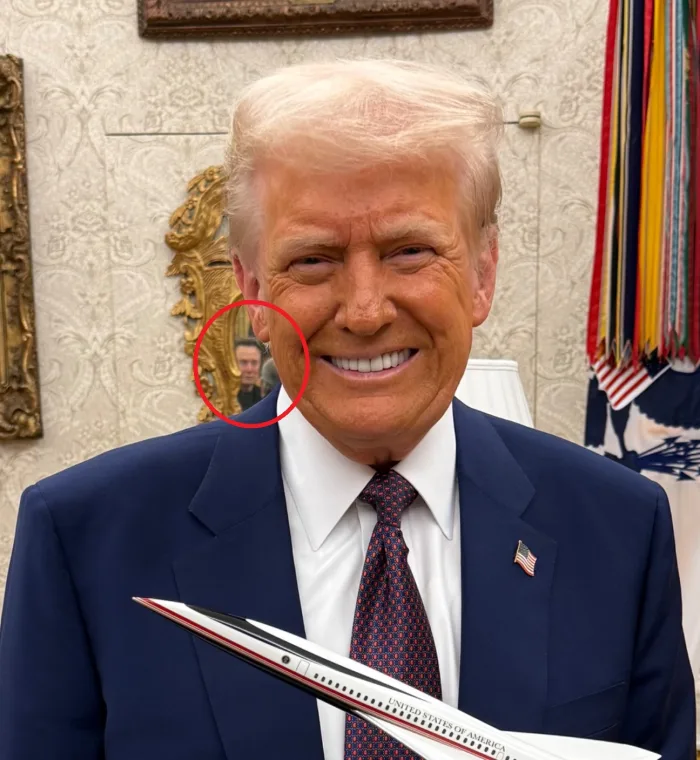
A striking new photo of former President Donald Trump in the Oval Office has captured the internet’s attention, not only because it features him holding a miniature model of Boom Aero’s Overture One—a cutting-edge supersonic jet that promises to redefine air travel—but also because of a subtle, almost eerie detail in the background. In the image, Trump beams while gripping the sleek, futuristic aircraft model, an object that has already captivated aviation enthusiasts and political observers alike. The Overture One, often dubbed the “son of the Concorde,” is designed to reach unprecedented speeds while offering luxury and efficiency, representing a bold leap forward in commercial and governmental aviation. Earlier this year, Boom Aero’s prototype, the XB-1, broke the sound barrier at 844 mph—exceeding the speed of sound by more than 80 mph—a feat that has made headlines in aerospace circles and fueled speculation about the next generation of Air Force One. The photograph, though, quickly became a viral sensation, not solely because of Trump’s promotion of supersonic travel, but because eagle-eyed viewers noticed a reflection in a mirror that many described as unsettling, sparking a whirlwind of online discussion and memes.
The photo, shared on social media by Blake Scholl, Boom Aero’s founder and CEO, immediately drew attention from aviation fans and Trump supporters alike. Scholl accompanied the image with a playful announcement, highlighting the availability of the miniature Overture One for pre-order in the company’s merchandise store. “Due to high demand, THIS very special Overture One model is now available for pre-order in the @boomaero Merch store! And these models are made in America!” he tweeted, a post that instantly garnered thousands of likes, comments, and shares. Followers were quick to ask logistical questions, curious about whether the aircraft itself would be produced in the United States or abroad, and when enthusiasts could expect to receive the collectible model. Scholl reassured them that production would indeed be domestic, and that shipping would commence in July, emphasizing the company’s commitment to quality and timeliness. Social media users eagerly debated the jet’s design, its potential impact on future Air Force One models, and how Trump’s promotion of the aircraft could signal renewed attention to American innovation in the aerospace sector. Beyond the technical excitement, the conversation soon shifted to a far more unexpected aspect of the photo—a reflection in the background that seemed to suggest someone entirely unexpected was present in the room.
If one examines the image closely, past the familiar contours of Trump’s profile, the polished wood and classic décor of the Oval Office, and the historical portraits and flags that line the walls, an uncanny detail emerges. In the reflection of a mirror positioned behind the president, social media users noticed what appeared to be Elon Musk, the billionaire entrepreneur and CEO of Tesla and SpaceX. While many initially thought it was a trick of light or a coincidental angle, further zoom-ins revealed Musk’s unmistakable profile, prompting reactions that ranged from amusement to genuine unease. One commenter described the image as “so creepy,” while another quipped, “Mirror, mirror on the wall, who’s the actual president of them all?” The internet quickly embraced the anomaly, with memes proliferating, jokes circulating about Musk “photobombing” the president, and speculation running wild about the implications of his presence. In the fast-moving culture of online commentary, even subtle background details in politically charged photographs can become flashpoints for discussion, and in this case, Musk’s reflection became a viral talking point that perhaps overshadowed the supersonic jet itself.
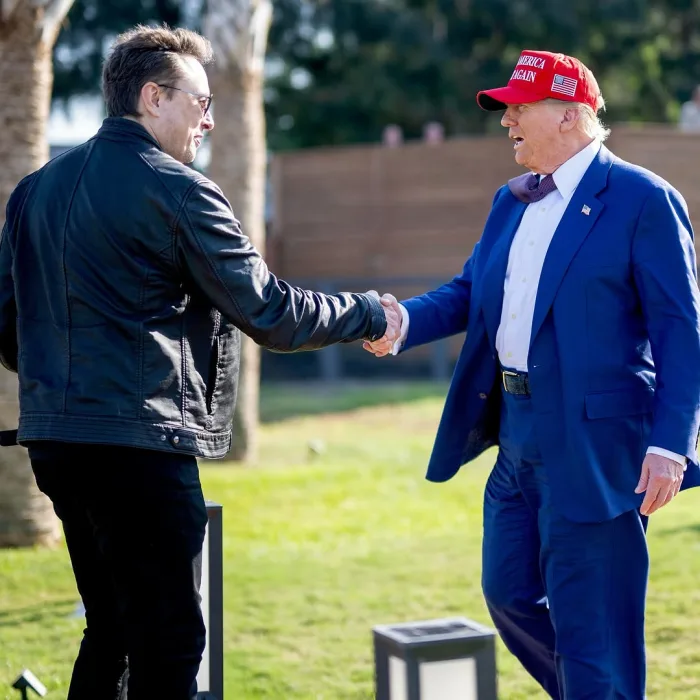
The dynamic between Trump and Musk adds another layer to the story, giving the photograph context beyond mere coincidence or playful internet speculation. Musk has recently been appointed to a high-profile role as co-lead of the newly established Department for Government Efficiency, known by its acronym, DOGE—a title that has prompted no shortage of humorous reactions online. Trump’s own comments about the appointment revealed his characteristic mixture of praise and levity. While acknowledging that he “settled” on Musk for the position, Trump also noted, “I couldn’t find anyone smarter,” a statement that reflects both admiration for Musk’s entrepreneurial prowess and a playful acknowledgment of the billionaire’s outsized reputation in technological innovation. The photograph, therefore, is not merely a whimsical scene of a former president holding a model airplane; it is a visual representation of a partnership that spans politics, technology, and national ambition. Observers have speculated that Musk’s presence signals a potential future in which innovation-driven leaders exert a more direct influence on governmental decision-making, particularly in areas related to efficiency, aerospace, and national infrastructure.
Meanwhile, the Overture One itself remains at the center of considerable interest, with implications that extend beyond novelty or collectible merchandise. The jet is designed for supersonic commercial flight, capable of traversing transcontinental distances in record time, and Boom Aero has been positioning it as the next logical step for both corporate and governmental aviation. The idea that such a high-speed aircraft could one day serve as Air Force One—a vehicle that has long symbolized American leadership and technological ambition—has captured the imagination of aviation enthusiasts, political commentators, and curious citizens alike. The prototype’s success in breaking the sound barrier represents not just a technological milestone, but a broader narrative of American innovation competing in a global aerospace market. Trump’s enthusiastic display of the model, coupled with Musk’s symbolic presence in the background, feeds into a storyline that combines futurism, celebrity influence, and the blending of private-sector ingenuity with public-sector ambition. It is a tableau that invites both admiration and scrutiny, highlighting the ways in which politics, technology, and popular culture intersect in the modern era.
The reactions to the photo illustrate the power of social media in shaping public perception. While some viewers focused primarily on the supersonic jet and its potential future applications, others became fixated on Musk’s reflected figure, generating a flurry of commentary that ranged from humorous to conspiratorial. Memes depicting the mirror scene circulated rapidly, often portraying Musk as a spectral presence or jokingly insinuating that he had become the “shadow president” of the United States. Beyond the entertainment factor, the photo underscores the heightened attention paid to visual media in contemporary politics. Every detail—the placement of objects, the reflections of individuals, the positioning of historical artifacts—can spark discussion, drive engagement, and even influence public perception of key figures. In this case, a single image has simultaneously fueled excitement about aerospace innovation, highlighted the unusual partnership between a former president and a tech billionaire, and reminded the public of the seemingly endless capacity of social media users to find—and amplify—the unexpected.
In the broader context, this photograph captures a moment that is emblematic of the current intersection between politics, celebrity, and technology. Trump’s presence in the Oval Office, coupled with his promotion of the Overture One model, positions him as both a nostalgic figure of American leadership and an active participant in promoting innovation. Musk’s reflection, whether intentional or serendipitous, serves as a symbolic reminder of the influence of private-sector innovators on public policy and governmental initiatives. Together, the image and the reactions it has inspired illustrate how modern narratives are shaped not only by actions and announcements but also by subtle visual cues and the viral potential of social media. As the Overture One moves closer to reality and Musk’s governmental role continues to unfold, the photo stands as a testament to the ongoing blending of ambition, visibility, and the power of a single, well-timed image to capture the imagination of millions around the world.