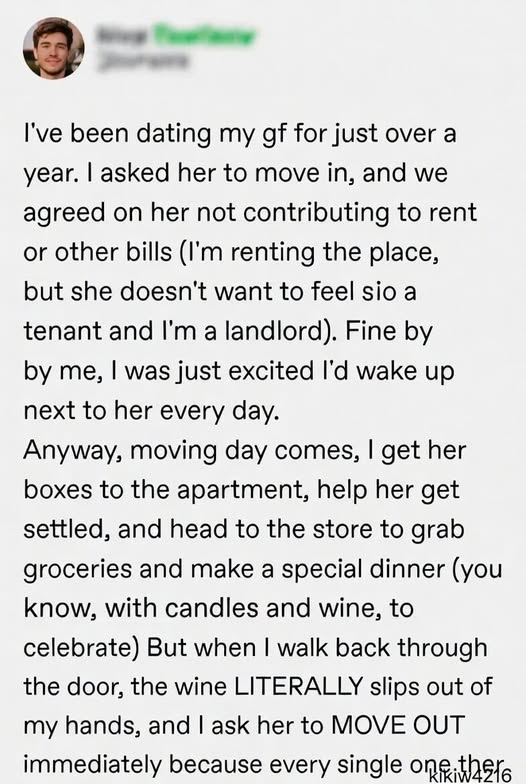
I had been dating Vanessa for fourteen months when I asked her to move in with me.
Fourteen months.
Three vacations together.
Hundreds of late-night phone calls.
Countless mornings waking up tangled together in hotel sheets or laughing over burnt pancakes in my kitchen.
I honestly thought I knew her.
That’s the part that still embarrasses me the most.
Not the breakup.
Not the screaming.
Not even the destroyed painting.
The embarrassing part is realizing how completely I convinced myself that I had finally found the right person.
At thirty-one, my life was stable in the quiet, adult way that doesn’t look impressive online but feels deeply satisfying when you’ve worked hard for it.
I had a decent apartment in Chicago.
A reliable job as a systems analyst for a healthcare company.
Good friends.
A small savings account.
A predictable routine.
Nothing glamorous.
But it was mine.
And after years of struggling through unstable jobs and terrible relationships in my twenties, stability felt sacred.
Then Vanessa arrived and turned everything brighter.
She had this magnetic energy that pulled people toward her instantly. She was funny in a sharp, intelligent way that made conversations addictive. She remembered tiny details about people and made them feel important. My coworkers adored her. My friends welcomed her immediately.
Even my guarded older sister, Claire, admitted Vanessa was charming.
Though I remember one strange comment Claire made after meeting her for the first time.
“She’s dangerously good at reading people.”
At the time, Claire laughed afterward like she was joking.
Now I think she saw something I missed.
Vanessa and I moved quickly.
Not recklessly.
Just naturally.
At least that’s how it felt.
By six months we were practically living together already. Half her clothes stayed at my apartment. Her makeup cluttered my bathroom counter. Her favorite coffee creamer permanently occupied space in my refrigerator.
So eventually the conversation about officially moving in together felt obvious.
One rainy Tuesday night, while we ate Thai food on my couch, I asked her.
“Move in with me.”
She stared at me for half a second before smiling so widely it made my chest ache.
“Yes,” she said immediately.
Then she added something unexpected.
“But I don’t want to pay rent.”
I remember blinking in confusion.
Not because I was angry.
Because the statement felt oddly sudden.
She noticed my hesitation immediately and grabbed my hand.
“I don’t want this weird power imbalance where it feels like I’m renting space from my boyfriend,” she explained softly. “I want this to feel like our home equally.”
Looking back now, I realize how manipulative that wording was.
But when you love someone, your brain becomes an attorney defending behavior your instincts already question.
She framed it emotionally.
Romantically.
And honestly, I could already afford the apartment alone. She often paid for groceries and dinners anyway. Besides, we talked constantly about marriage and future plans.
So I agreed.
Actually, I felt proud of agreeing.
I thought generosity proved commitment.
That was mistake number one.
Moving day arrived in October during one of those cold Chicago rainstorms that seem determined to ruin every cardboard box in existence.
Vanessa arrived with an overwhelming amount of belongings.
Throw pillows.
Decorative candles.
Plants.
Framed prints.
At least nineteen beige sweaters.
By noon, my apartment looked like a lifestyle influencer had exploded inside it.
But Vanessa was happy.
Really happy.
She danced around the living room barefoot while unpacking kitchen supplies, laughing constantly.
At one point she wrapped her arms around my neck and whispered, “We’re finally building a real home.”
I kissed her forehead and believed every word.
That memory still hurts.
By late afternoon, most of the heavy lifting was done.
Vanessa wanted to continue organizing clothes while I ran out to buy groceries for our first official dinner living together.
I planned everything carefully because I wanted the night to feel special.
Steaks.
Roasted potatoes.
Candles.
Cheesecake from the bakery she loved downtown.
And a bottle of expensive red wine I couldn’t really afford but bought anyway because I felt absurdly happy.
I remember walking back toward the apartment feeling lucky.
Like life had finally settled into something beautiful.
The rain had stopped.
The city smelled cold and clean.
I was already imagining us years later telling our future kids about our first night living together.
Then I opened the apartment door.
And the wine bottle slipped from my hand immediately.
Glass shattered across the hardwood floor.
Red wine exploded everywhere like blood.
Because directly above the fireplace hung the one thing I had specifically told Vanessa never to touch.
My mother’s painting.
Destroyed.
Not damaged.
Destroyed.
The canvas had been sliced straight through the middle.
For several seconds, my brain genuinely stopped functioning.
I just stared.
My mother painted that artwork six months before she died from ovarian cancer.
It was the last piece of art she ever completed.
The last physical thing she created with her own hands.
And now it hung ripped apart like trash.
Vanessa walked casually into the living room carrying decorative candles.
“Oh,” she said lightly. “You’re home.”
I couldn’t breathe properly.
“What…”
My voice cracked.
“What happened?”
She glanced toward the fireplace with complete indifference.
“I redecorated.”
I stared at her.
“You destroyed it.”
She rolled her eyes immediately.
“Ethan, calm down.”
Calm down.
Those words nearly made me black out.
“That was my mother’s painting.”
“I know.”
“Then why would you touch it?”
She sighed dramatically like I was making the situation difficult unnecessarily.
“Because it was ugly.”
I honestly thought I misheard her.
“What?”
“It didn’t fit the apartment aesthetic.”
Aesthetic.
My dead mother’s final painting had become an aesthetic inconvenience.
I walked slowly toward the fireplace.
The cut through the canvas was perfectly deliberate.
Clean.
Intentional.
Careful.
This wasn’t an accident.
She had physically stood there and chosen to destroy something irreplaceable.
I turned back toward her.
“You cut it.”
“It’s just an old painting.”
The word just almost physically hurt.
I looked around the apartment for the first time.
That’s when I realized the painting wasn’t the only thing she changed.
My bookshelf had been rearranged by color instead of author.
The framed photo of my father had disappeared.
My leather reading chair was gone.
The ceramic bowl my grandmother gave me wasn’t on the kitchen counter anymore.
Panic crawled slowly up my spine.
“Where are my things?”
Vanessa crossed her arms defensively.
“I made improvements.”
“Where are my things?”
“In storage bins.”
“You boxed up my furniture?”
“Well obviously we couldn’t keep random bachelor furniture everywhere.”
I felt nauseous.
“Without asking me?”
“You would’ve said no.”
The honesty of that answer stunned me.
No shame.
No guilt.
She genuinely believed bypassing my consent was acceptable because my disagreement would have inconvenienced her.
I opened the hallway closet.
My belongings were stacked inside like unwanted junk.
Books.
Photographs.
Keepsakes.
Pieces of my identity shoved away within hours of her moving in.
Then I saw the empty wooden frame from my mother’s painting leaning beside a garbage bag.
Something inside me broke completely.
“Get out.”
Vanessa blinked in disbelief.
“What?”
“Move out.”
She laughed once.
“You’re joking.”
“No.”
“You’re seriously throwing me out over a painting?”
That sentence echoed in my head.
Over a painting.
As though this was about decoration.
As though grief was replaceable.
As though memories were meaningless clutter.
“You destroyed the last thing my mother ever made.”
“She painted other things.”
“No,” I said quietly. “She didn’t. She died six months later.”
For the first time all day, Vanessa looked slightly uncomfortable.
But only slightly.
“I didn’t realize it mattered this much.”
“Yes,” I replied. “You did.”
Because she knew the story already.
I told her about that painting on our third date.
I remembered the exact restaurant.
The exact table.
The exact way she squeezed my hand sympathetically while I talked about losing my mother at nineteen.
She knew exactly what it meant.
She simply decided her preferences mattered more.
“I need you to leave.”
Her face hardened instantly.
“You are massively overreacting.”
“No,” I said calmly. “I’m reacting appropriately.”
“You’re choosing an object over our relationship.”
That sentence clarified everything.
Because to Vanessa, emotional attachment only mattered when she personally understood it.
Empathy had conditions.
I walked silently into the bedroom, grabbed her suitcase from the closet, and placed it beside the front door.
That’s when she realized I meant it.
“Ethan.”
“Pack your things.”
She started crying immediately.
Violently.
Like a faucet turning on.
“You’re abandoning me over one mistake!”
But even through the tears, something felt strangely artificial.
Performative.
And suddenly I started replaying our entire relationship differently.
Every disagreement somehow becoming my fault.
Every argument ending with me apologizing.
Every boundary gradually pushed until defending myself felt exhausting.
I remembered Claire once warning me carefully.
“She’s very good at becoming the victim.”
At the time, I defended Vanessa fiercely.
Now I wondered how many people before me had already learned this lesson.
“I need you to leave,” I repeated quietly.
Vanessa stared at me for several long seconds.
Then the tears stopped instantly.
Gone.
Like they had never existed.
That sudden emotional switch frightened me more than the yelling would have.
“You’ll regret this,” she said coldly.
Maybe a weaker version of me would’ve backed down then.
But I kept looking at my mother’s ruined painting.
And I realized something simple and undeniable.
Anyone who truly loved me would have protected that painting carefully.
Not destroyed it for visual symmetry.
“No,” I replied softly. “I’ll regret not seeing this sooner.”
The next two hours felt surreal.
Vanessa packed while alternating between crying, insulting me, and calling friends dramatically to describe me as emotionally unstable.
At one point she accused me of psychologically abusing her because I refused to discuss “compromises.”
Compromises.
For slicing apart my dead mother’s artwork.
When her friend Alyssa arrived to help carry boxes downstairs, she looked deeply uncomfortable after noticing the ruined canvas near the fireplace.
“What happened?” Alyssa asked carefully.
Vanessa answered immediately.
“He’s throwing me out over decoration.”
Alyssa looked at the painting.
Then at me.
Then back at Vanessa.
And in that exact moment, I watched another person realize something deeply wrong about her.
Not eccentric.
Not emotional.
Wrong.
By midnight, she was gone.
The apartment became painfully silent again.
I sat alone on the floor staring at the destroyed painting for nearly an hour before finally crying.
Not dramatic movie tears.
The ugly kind.
The exhausted kind.
The kind that comes from realizing someone you loved never respected the most fragile parts of you.
The next morning Claire came over immediately after hearing what happened.
The second she saw the painting, her entire face changed.
“Oh my God.”
I nodded silently.
Claire crouched beside me.
“She did this on purpose.”
“I know.”
“She wanted to see whether you’d let her.”
That sentence haunted me.
Because deep down, I knew Claire was right.
The painting wasn’t the true target.
The boundary was.
Could Vanessa erase parts of my identity for her comfort?
Could she reshape my life without permission?
Could she override emotional significance because her preferences mattered more?
And for fourteen months, the answer had mostly been yes.
Until now.
Over the next few weeks, disturbing truths kept surfacing.
Friends quietly admitted Vanessa mocked me behind my back sometimes.
Coworkers revealed she flirted constantly for attention.
One of her former roommates even messaged me privately.
“Be careful,” she wrote. “When Vanessa loses control of a relationship, she becomes vindictive.”
At first I thought that sounded dramatic.
Then the social media posts started.
Nothing direct enough to cause legal problems.
Just carefully crafted victim narratives about “emotionally unsafe men” and “being punished for trying to build a beautiful home.”
Strangers flooded her comments with sympathy.
That part bothered me more than I expected.
Not because I wanted revenge.
Because manipulative people are often incredibly convincing publicly.
They know how to weaponize vulnerability.
About a month later, I took the damaged painting to an elderly art restoration specialist named Leonard.
He examined it quietly beneath bright lights for a long time.
Finally he sighed.
“I can repair most of it,” he said gently. “But the scar will never completely disappear.”
I swallowed hard.
“That’s okay.”
And strangely, I meant it.
Because by then I understood something important.
Pretending damage never happened doesn’t heal anything.
Some scars deserve visibility.
When Leonard returned the restored painting weeks later, the repaired line remained faintly visible beneath certain light.
At first the imperfection hurt to see.
Then gradually it started meaning something else.
Survival.
Several months after the breakup, Vanessa emailed me unexpectedly.
The message was long.
Not an apology exactly.
Mostly explanations.
Stress.
Moving anxiety.
Feeling judged.
Wanting the apartment to feel shared.
Then near the end, one sentence stood out.
“You chose objects over our future.”
I reread that line at least ten times.
Then finally understood why our relationship failed.
Because she genuinely believed the issue was the object itself.
Not respect.
Not empathy.
Not consent.
To Vanessa, emotional attachment was irrational unless she personally valued it.
I never replied.
Eventually I started therapy.
Not only because of the breakup.
Because the relationship forced me to confront how loneliness had lowered my standards.
My therapist said something during one session that changed how I viewed everything.
“Healthy love protects your humanity,” she told me. “Control slowly replaces it.”
I thought about that constantly afterward.
About how often I minimized discomfort to keep peace.
How many small boundaries I surrendered because conflict made me anxious.
How easily accommodation became confused with love.
Almost a year later, Claire invited me over for dinner.
Halfway through the meal, she asked something unexpected.
“Do you know why Mom painted that picture?”
I shook my head.
Claire smiled sadly.
“She painted it after chemo. She told me she wanted to create something peaceful because she was afraid you’d only remember her being sick.”
My throat closed instantly.
Claire squeezed my hand gently.
“She loved you so much.”
That night I drove home crying again.
But differently this time.
Not from grief.
From clarity.
The painting was never just paint and canvas.
It was proof.
Proof that my mother thought about me even while dying.
Proof that love leaves things behind intentionally.
Proof that memories deserve protection.
When I got home, I stood in front of the restored painting for a long time.
The repaired scar remained visible beneath the hallway light.
And suddenly I realized something strange.
The painting looked stronger now.
Not because it had been damaged.
Because it survived being damaged.
Kind of like me.
Six months later, I met someone new.
Her name was Julia.
On our fifth date, she came over for dinner.
At one point she noticed the painting above the fireplace.
“It’s beautiful,” she said softly.
Then she asked about it carefully, like someone aware memories can bruise.
So I told her the truth.
Not just about my mother.
About everything.
The relationship.
The destruction.
The breakup.
Julia listened quietly without interrupting.
When I finished, she looked back at the painting for several seconds.
Then she said something I’ll probably remember forever.
“I’m glad you protected it.”
That was all.
No minimizing.
No judgment.
No defensiveness.
Just understanding.
And in that moment, I finally understood what emotional safety actually feels like.
Not intensity.
Not obsession.
Not emotional chaos disguised as passion.
Safety.
The kind where your grief is handled gently.
Where your memories are respected.
Where the fragile parts of you are not treated like obstacles to redesign.
Sometimes people ask whether I regret ending things with Vanessa so quickly.
I always answer honestly.
No.
Because relationships are not destroyed by one moment.
They are revealed by one moment.
And when I opened that apartment door and saw my mother’s painting sliced apart above the fireplace, I finally saw the truth clearly enough to stop lying to myself.
The wine bottle slipped from my hands because deep down, before my mind fully understood it, my body already knew something devastating.
The woman standing inside my apartment did not truly love me.
She loved access to me.
There is a difference.
And learning that difference probably saved the rest of my life.