At first, I told myself it wasn’t worth remembering.
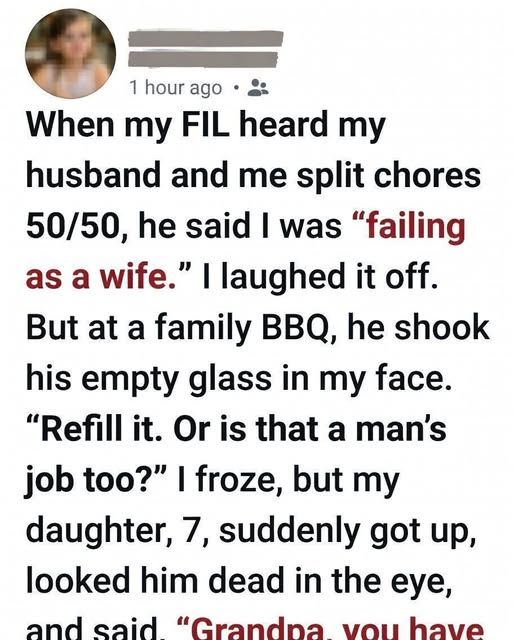
When my father-in-law laughed after hearing that my husband helped clean the kitchen after dinner, I smiled politely and let the comment slide past me like smoke in the wind.
“You’re failing as a wife,” he joked, shaking his head while sipping iced tea on our back patio. “A man shouldn’t be scrubbing dishes after work.”
Everyone around the table chuckled lightly.
Not cruelly.
Not maliciously.
Just the kind of laughter people use when they are trying to avoid discomfort.
I smiled too, mostly because arguing felt exhausting.
But even comments we pretend not to care about have a way of settling quietly inside us.
The words stayed with me longer than I wanted them to.
Not because I doubted our marriage.
I didn’t.
My husband and I had built something strong together — something balanced and honest in a way that worked beautifully for us.
We didn’t divide life into “his responsibilities” and “my responsibilities.”
We simply shared life.
Some nights I cooked while he folded laundry.
Other days he made dinner while I helped our daughter with homework.
When one of us was overwhelmed, the other stepped in automatically without keeping score.
It was never about proving a point.
It was about partnership.
And honestly, it made our home peaceful.
Still, hearing someone reduce that partnership to failure left a small bruise somewhere inside me.
Not large enough to create conflict.
Just noticeable enough that I kept replaying the moment afterward while driving home that night.
Maybe because part of me knew it wasn’t really a joke.
It was judgment wrapped in humor.
And that difference matters.
A week later, we gathered again for another family barbecue at my in-laws’ house.
The afternoon felt warm and easy at first.
Children chased each other across the yard while music played softly from an old outdoor speaker. The smell of grilled meat and fresh bread drifted through the air, mixing with laughter and clinking glasses.
For a while, everything felt normal.
Safe.
I let myself relax.
My husband stood beside the grill flipping burgers while talking football with his brother. Our daughter Lily sat nearby coloring quietly at the patio table, occasionally humming to herself while carefully switching between crayons.
I watched her for a moment and smiled.
Seven years old.
Bright-eyed.
Gentle.
Always listening more carefully than people realized.
That was one of the beautiful and terrifying things about children.
They absorb everything.
Not only the lessons we intentionally teach them.
But the ones we accidentally model every single day.
The barbecue continued peacefully until my father-in-law approached carrying an empty glass.
Without looking directly at me, he extended it casually in my direction.
“Refill this for me,” he said.
Then came the pause.
The half-smile.
The comment that followed.
“Or is that a man’s job too these days?”
A few people laughed awkwardly.
Not loudly.
Just enough to acknowledge the joke without fully committing to it.
But this time, something felt different.
Maybe because it wasn’t private anymore.
Maybe because it happened in front of everyone.
Or maybe because I suddenly realized how often women are expected to absorb small humiliations quietly in order to preserve peace for everyone else.
Conversations around the patio slowed noticeably.
I could feel people waiting.
Watching.
Wondering whether I would laugh again or finally respond.
For one long second, I froze.
Not because I lacked words.
Because I was deciding whether the emotional cost of speaking was worth paying.
Silence is tempting sometimes.
Especially in families.
Especially for women taught that harmony matters more than honesty.
Part of me prepared to smile again.
To refill the glass.
To move on.
Then I heard the scrape of a chair against concrete.
Soft.
Small.
But enough to shift the entire moment.
I turned toward the sound and saw Lily standing beside the patio table.
Her crayon still rested in her hand.
Her expression remained calm and thoughtful, not angry or dramatic.
She looked directly at her grandfather with complete sincerity.
“Grandpa,” she said gently, “in our house everybody helps. That’s what makes things fair.”
The entire yard fell silent.
Not tense silence.
Reflective silence.
The kind that settles when something unexpectedly truthful enters the room.
My father-in-law lowered his glass slowly.
At first, I worried he might become defensive or embarrassed.
But instead, something softer crossed his face.
Surprise.
Then thoughtfulness.
Lily hadn’t challenged him with disrespect.
Hadn’t raised her voice.
Hadn’t tried to shame him.
She simply stated what she believed to be normal.
And somehow, that honesty carried more power than any argument ever could.
Nobody spoke for several seconds.
Even the children nearby seemed quieter somehow, as though they instinctively understood something important had happened.
Finally, my husband stepped forward beside me.
Without saying a word, he gently took the empty glass from his father’s hand and walked toward the cooler to refill it himself.
No performance.
No confrontation.
Just quiet certainty.
A few relatives exchanged small smiles.
Conversations eventually resumed, though the atmosphere had shifted subtly.
Softer now.
More thoughtful.
My father-in-law remained unusually quiet for most of the afternoon.
Once or twice, I caught him watching Lily while she colored at the table, his expression unreadable.
Later that evening, after the barbecue ended and we began walking home beneath the fading gold of sunset, I reached for Lily’s hand.
She slipped her tiny fingers into mine naturally.
As though nothing unusual had happened.
To her, maybe nothing had.
She hadn’t spoken to make a statement.
She simply reflected the world she knew.
A world where love looked like cooperation.
Where respect wasn’t measured through authority.
Where helping each other wasn’t weakness.
It was family.
As we walked, I realized something quietly profound.
Children don’t learn values primarily through lectures.
They learn by watching.
Watching who apologizes.
Who listens.
Who carries the heavier load without complaint.
Who treats others with dignity when nobody is paying attention.
Every ordinary interaction becomes part of their blueprint for adulthood.
Lily understood fairness because she lived inside it every day.
Not perfectly.
No family is perfect.
But consistently enough that equality felt natural to her rather than revolutionary.
That realization moved me more deeply than I expected.
Because the moment at the barbecue wasn’t really about my father-in-law’s comment anymore.
It was about what happens when a child grows up witnessing mutual respect instead of rigid expectations.
It was about the quiet confidence that develops when children see partnership modeled consistently in front of them.
That night, after Lily fell asleep, my husband and I sat together in the kitchen finishing leftover lemonade.
The house was peaceful.
He looked at me carefully.
“You okay?”
I nodded slowly.
“Yeah,” I admitted. “I think so.”
Then I laughed softly.
“I still can’t believe she said that.”
He smiled.
“She learned it somewhere.”
For a moment, neither of us spoke.
Then he reached across the table and squeezed my hand gently.
And I realized something else.
The most meaningful victories in life rarely happen during loud arguments or dramatic confrontations.
Sometimes they happen quietly.
In small moments.
In ordinary backyards.
Through children who speak honestly because nobody has yet taught them to silence themselves for the comfort of others.
My father-in-law never apologized directly.
But something changed afterward.
Subtle things.
He stopped making jokes about household roles.
Started thanking people more often.
Even offered to help clean after future family dinners — awkwardly at first, but sincerely.
Nobody demanded it.
Nobody lectured him.
A seven-year-old child simply held up a mirror to a different way of living.
And somehow, that proved enough.
Months later, I still think about that afternoon sometimes.
Not because of the insult.
But because of what came after it.
Because in one simple sentence, my daughter reminded everyone at that barbecue of something many adults forget:
Respect is not proven through control.
It is reflected through kindness.
Through fairness.
Through shared responsibility.
Through the willingness to stand beside each other instead of above each other.
And perhaps most importantly—
through the example we choose to set for the next generation watching quietly from nearby.