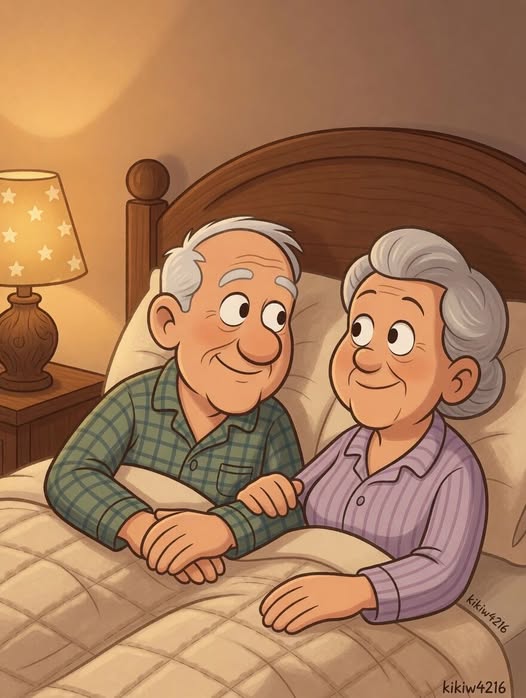
The hospital room was unusually quiet except for the soft hum of machines and the rhythmic ticking of a clock mounted above the door.
Late afternoon sunlight slipped weakly through partially closed curtains, painting pale streaks across the blanket covering Henry’s frail body. The once broad-shouldered man who had spent decades golfing, fixing engines in his garage, and proudly mowing his lawn every Saturday morning now looked impossibly small against the white hospital pillows.
Martha sat beside him in the same chair she had occupied nearly every day for the last three weeks.
Her hand rested gently over his.
After fifty-two years of marriage, the gesture required no thought. Their fingers fit together naturally, worn into familiarity by decades of shared life.
They had survived nearly everything together.
Financial hardship.
Family arguments.
Health scares.
The loss of parents.
The chaos of raising three children.
And all the ordinary storms that quietly test a marriage over time.
Now they sat together in the silence of what both understood might be their final evening.
Henry’s breathing was shallow but steady. Every few moments his chest rattled faintly before settling again.
Martha hated that sound.
She hated the smell of antiseptic.
The pale walls.
The sympathy in nurses’ eyes.
Most of all, she hated how small mortality made even the strongest people seem.
Henry opened his eyes slowly and turned toward her.
“Martha,” he whispered weakly.
She leaned closer instantly.
“Yes, sweetheart?”
His lips trembled slightly as though the effort of speaking exhausted him.
“There’s something I need to ask you before I go.”
Her chest tightened painfully.
Over the years, they had learned to speak honestly with one another. Age had stripped away much of the pride younger couples cling to.
Still, something about his expression unsettled her.
“What is it?” she asked softly.
Henry swallowed carefully.
“Have you ever been unfaithful to me?”
The question seemed to freeze the room.
Even the ticking clock suddenly sounded louder.
Martha stared at him silently.
In fifty-two years of marriage, he had never once asked her that.
Not during difficult years.
Not during arguments.
Not during moments of insecurity.
Never.
She looked down at her wedding ring, slowly twisting it around her finger.
The gold band had become thinner over time, worn smooth by decades of dishes, laundry, gardening, child-rearing, and life itself.
She could have lied.
At his age, in his condition, perhaps most people would have.
But something about death strips away unnecessary performance.
And Henry had always deserved honesty.
Her voice came out almost as a whisper.
“Yes.”
His eyebrows lifted weakly.
She saw pain flicker briefly across his face, but before it could settle fully, she squeezed his hand tighter.
“Three times,” she admitted quietly.
Henry blinked slowly.
For several seconds neither spoke.
Then finally he croaked, “Three?”
She nodded carefully.
“But always for a reason.”
A faint mixture of confusion and curiosity crossed his expression.
After all these years, Henry knew his wife well enough to understand one thing:
Nothing Martha ever did was careless.
She was practical.
Protective.
Fiercely loyal in her own complicated way.
Even now, despite the shock of her confession, part of him instinctively believed there had to be more to the story.
His voice cracked softly.
“Tell me.”
Martha took a slow breath.
“The first time,” she began gently, “was when we almost lost the house.”
Immediately Henry’s eyes shifted with recognition.
Even after decades, he remembered that period vividly.
The foreclosure notices.
The unpaid bills.
The sleepless nights sitting at the kitchen table staring at numbers that never added up.
Back then Henry had worked two jobs after the factory downsized unexpectedly. Martha had taken temporary work cleaning offices at night while still raising their children during the day.
Still, they fell behind.
Every month brought another red warning notice.
Henry remembered the humiliation most of all.
The shame of feeling like he had failed his family.
“One afternoon,” Martha continued quietly, “I went to speak with the banker.”
Henry’s brow tightened faintly.
“He wouldn’t approve another extension,” she explained. “He said the paperwork was final.”
Henry remembered punching the steering wheel in frustration after hearing that news.
“We were going to lose everything,” Martha said softly. “The kids would’ve had nowhere stable to live.”
She paused.
Then finally added:
“So I convinced him to reconsider.”
Henry stared at her.
Understanding slowly dawned across his tired face.
“The next morning,” she continued carefully, “our mortgage extension was approved.”
For a long moment Henry said nothing.
Then surprisingly, the corners of his mouth twitched upward slightly.
“You saved the house,” he whispered.
Martha’s eyes filled with tears.
“I couldn’t let us lose it.”
Henry closed his eyes briefly.
That house had held their entire life.
Birthday parties.
Christmas mornings.
Late-night talks in the kitchen.
Their children’s height marks penciled onto the hallway wall.
“You did what you had to do,” he murmured softly.
There was no anger in his voice.
Only gratitude.
Martha leaned down and kissed his forehead gently.
For a few moments, silence settled comfortably between them again.
Then Henry opened one eye slightly.
“And the second time?”
Martha exhaled slowly.
“This one happened during your heart surgery.”
Immediately his expression changed.
Twelve years earlier, Henry had nearly died after suffering a massive heart attack while shoveling snow from the driveway.
The surgery had been urgent.
Expensive.
Terrifying.
Insurance covered only part of it.
The remaining costs were impossible.
Henry remembered Martha crying quietly beside his hospital bed late one night while pretending everything would somehow work out.
“The surgeon said he couldn’t proceed without financial authorization,” she explained softly.
Henry frowned faintly.
“I visited him after hours,” she continued.
Understanding hit him quickly.
“Oh.”
She nodded once.
“The next morning,” she said gently, “he agreed to perform the procedure without additional payment.”
Henry stared at her for several seconds.
Then unexpectedly, he laughed.
Not loudly.
Not strongly.
Just a fragile, raspy chuckle that shook weakly through his chest.
“You seduced a cardiologist to save my life?”
“I preferred to think of it as negotiating creatively,” Martha replied with dignity.
Henry laughed harder this time, though it quickly turned into coughing.
She reached for water immediately.
“Easy,” she said softly.
After catching his breath, he looked at her with watery eyes.
“You gave me another decade,” he whispered.
Martha smiled sadly.
“I wanted more than that.”
Henry squeezed her hand weakly.
For a long moment he simply stared at her.
Not with resentment.
Not with betrayal.
But with awe.
After fifty-two years, she was still surprising him.
Finally he whispered:
“And the third time?”
Martha hesitated.
Then something unexpected happened.
She smiled.
Not sadly.
Not nervously.
Mischievously.
Henry immediately narrowed his eyes suspiciously.
“Oh no,” he murmured weakly. “That smile means trouble.”
Martha laughed softly for the first time all day.
“Do you remember when you ran for president of the Lakeside Golf Club?”
Henry blinked.
Even through illness, a faint spark of pride appeared in his expression.
“Of course I remember,” he said. “I won by seventy-three votes.”
Martha nodded thoughtfully.
“Yes,” she replied. “About that.”
Henry stared at her blankly.
Then slowly his eyes widened.
“No.”
Martha bit her lip, unsuccessfully suppressing laughter.
“You needed exactly seventy-three more votes to beat Harold Patterson,” she explained.
Henry looked horrified.
“Martha…”
“So,” she continued innocently, “I spent that week doing some… campaigning.”
Henry’s jaw dropped weakly.
“You’re kidding.”
She shook her head.
“Every vote mattered.”
For two full seconds, silence filled the room.
Then Henry suddenly burst into laughter.
Real laughter.
Weak and breathless, but genuine.
The sound startled even Martha.
“You mean to tell me,” he wheezed between laughs, “that my entire golf club presidency was built on—”
“Community outreach,” Martha interrupted firmly.
Henry laughed so hard tears streamed from the corners of his eyes.
“Seventy-three members?”
“Well,” Martha said thoughtfully, “technically seventy-one members and two assistant groundskeepers.”
Henry groaned dramatically.
“My God.”
“You did make an excellent president,” she pointed out.
“I spent three years bragging about that election!”
“You earned every vote,” Martha said with perfect seriousness.
Henry laughed again, shaking his head weakly against the pillow.
“That explains why Harold refused to speak to me for six months.”
“He was a terrible golfer anyway,” Martha replied dismissively.
For several beautiful minutes, the room transformed completely.
The fear.
The grief.
The heaviness.
All temporarily replaced by laughter.
A nurse passing by glanced inside, visibly surprised to hear two elderly people laughing hysterically in what had moments earlier seemed like a solemn deathbed vigil.
Henry wiped tears from his eyes carefully.
“I can’t believe this,” he whispered.
Martha smiled warmly.
“I couldn’t let you lose.”
Henry stared at her for a long moment.
Then finally he said softly:
“You spent our entire marriage fighting for me, didn’t you?”
The humor faded gently into something deeper.
Martha looked down at their intertwined hands.
“I spent our marriage fighting for us.”
That answer seemed to settle somewhere deep inside him.
The room grew quiet again, but now the silence felt peaceful rather than heavy.
Henry’s breathing slowed gradually.
After several minutes he spoke again, softer this time.
“You know something funny?”
“What?”
“I thought love was about loyalty.”
Martha frowned slightly.
“It is.”
Henry shook his head weakly.
“No,” he whispered. “I think it’s about showing up.”
She looked at him silently.
“You showed up every single time,” he continued quietly. “Even when things were ugly. Even when life got hard.”
Martha’s eyes filled with tears.
“You showed up too,” she whispered.
Henry smiled faintly.
“Not like you.”
For a long time neither spoke.
The evening light slowly dimmed outside the window.
Finally Henry broke the silence one last time.
“You know,” he murmured weakly, “most men spend their final hours wondering whether their wives loved them enough.”
Martha squeezed his hand gently.
“And you?”
A slow smile spread across his tired face.
“I’m sitting here realizing mine loved me enough to seduce bankers, blackmail cardiologists, and apparently sleep her way through an entire golf club election.”
Martha burst into laughter through her tears.
Henry joined her weakly.
The sound echoed warmly through the quiet hospital room.
Then eventually his laughter softened.
His eyes drifted toward hers one final time.
“I had a good life,” he whispered.
Martha leaned forward carefully and kissed his forehead.
“You gave me one too.”
The clock continued ticking quietly above the door.
The machines hummed softly in the fading light.
And there, between laughter and goodbye, two imperfect people who had spent more than half a century choosing each other sat hand in hand—still finding ways to make one another smile until the very end.